PACE Foliage Updates - North America



PACE Fall Foliage Updates
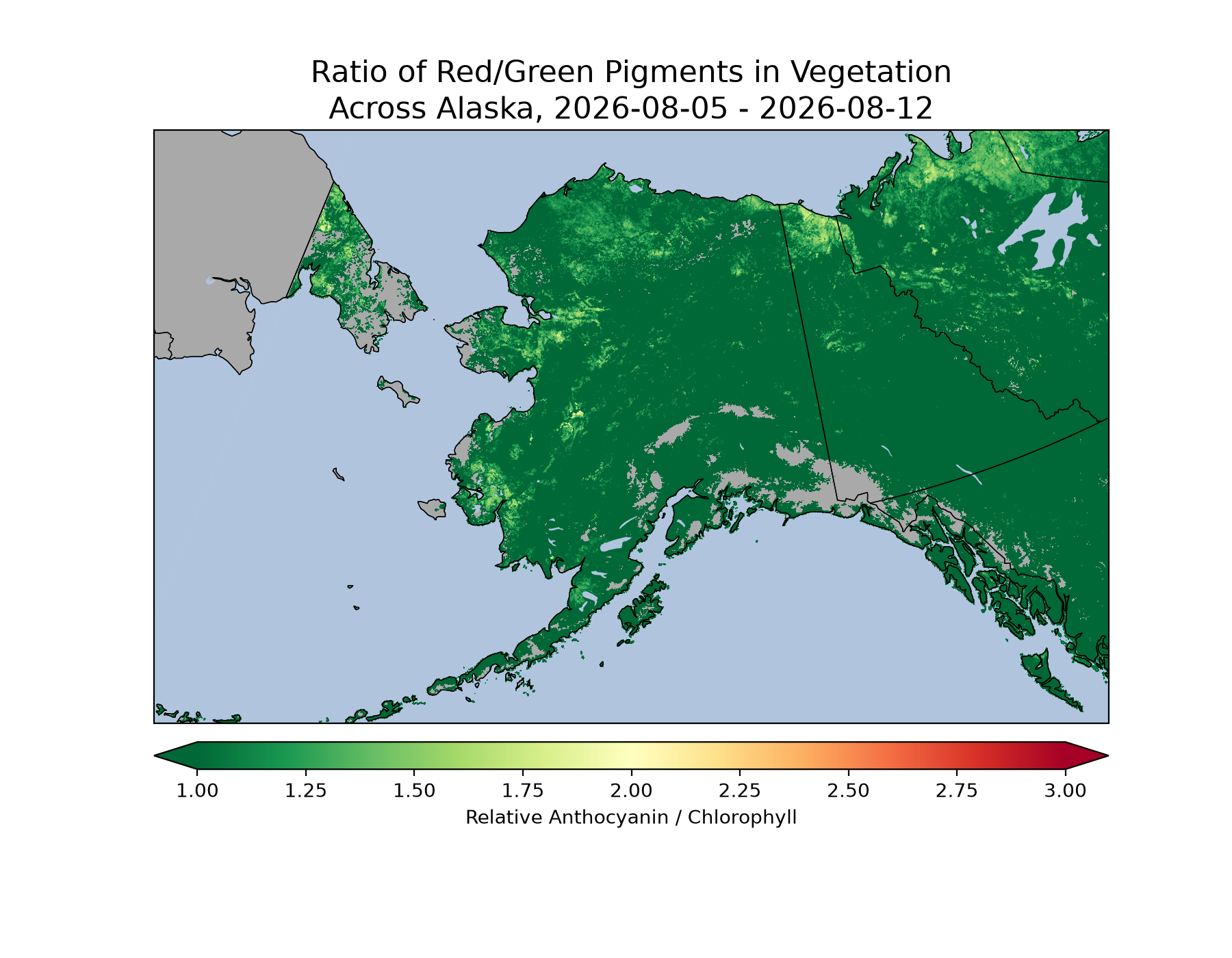
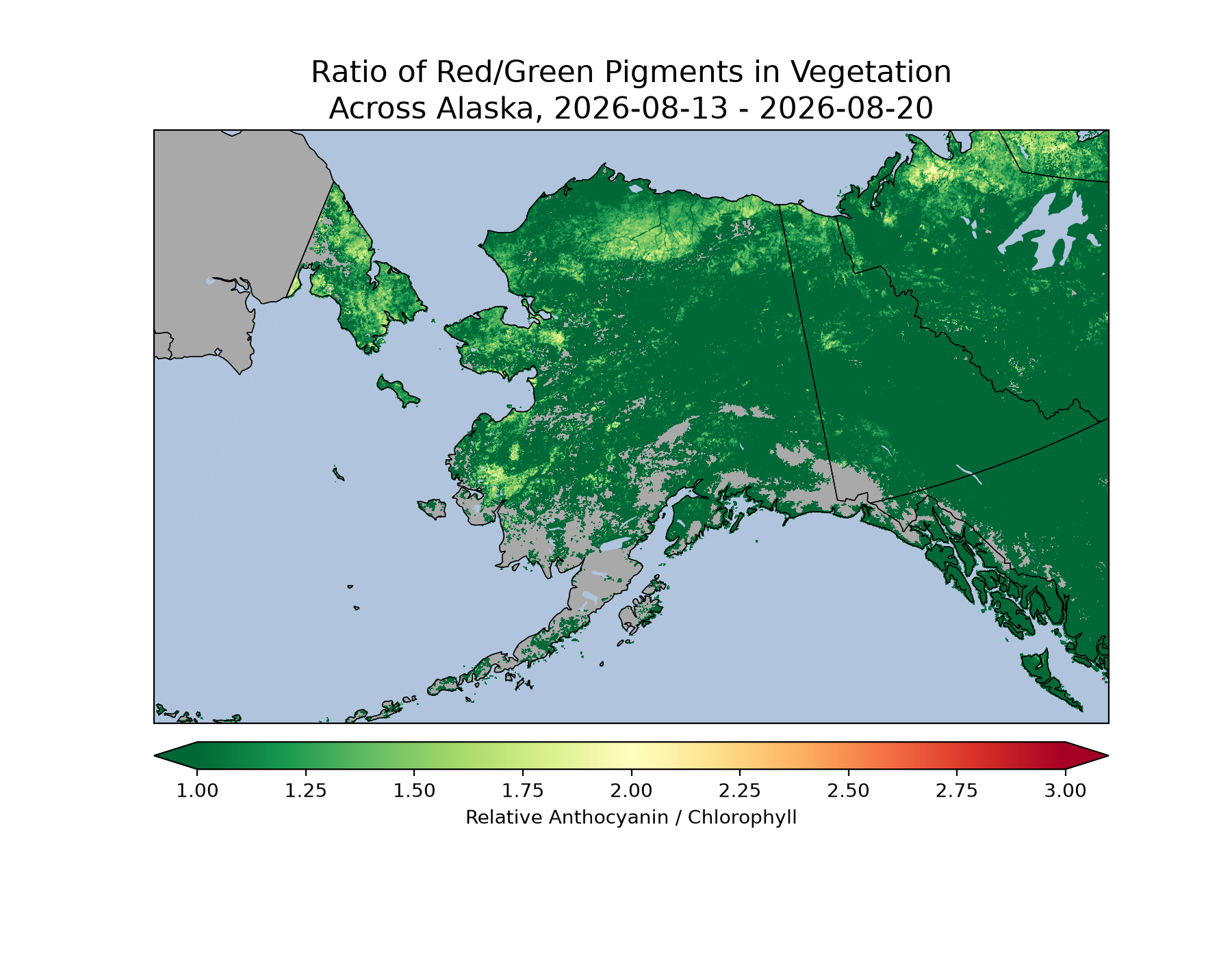
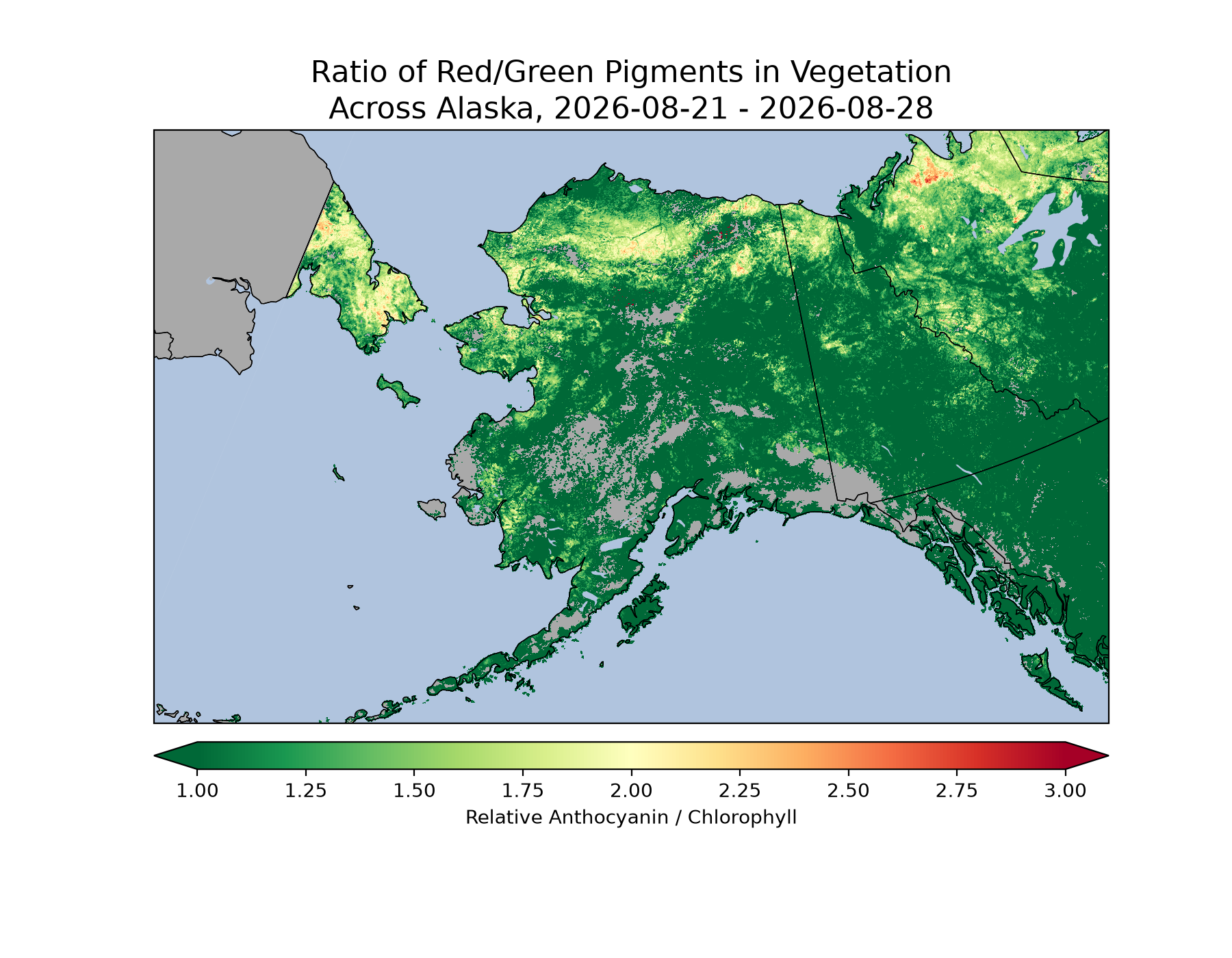
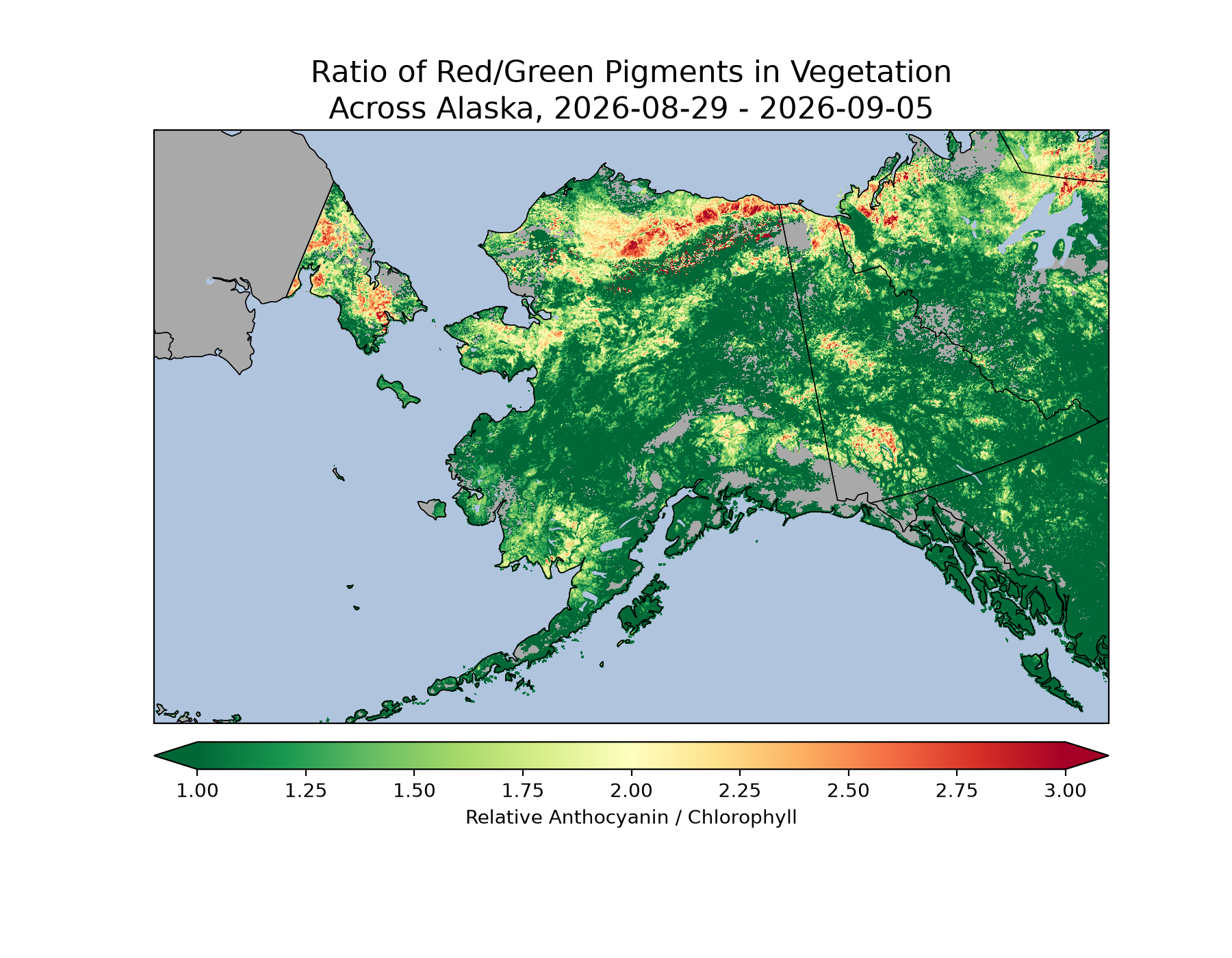
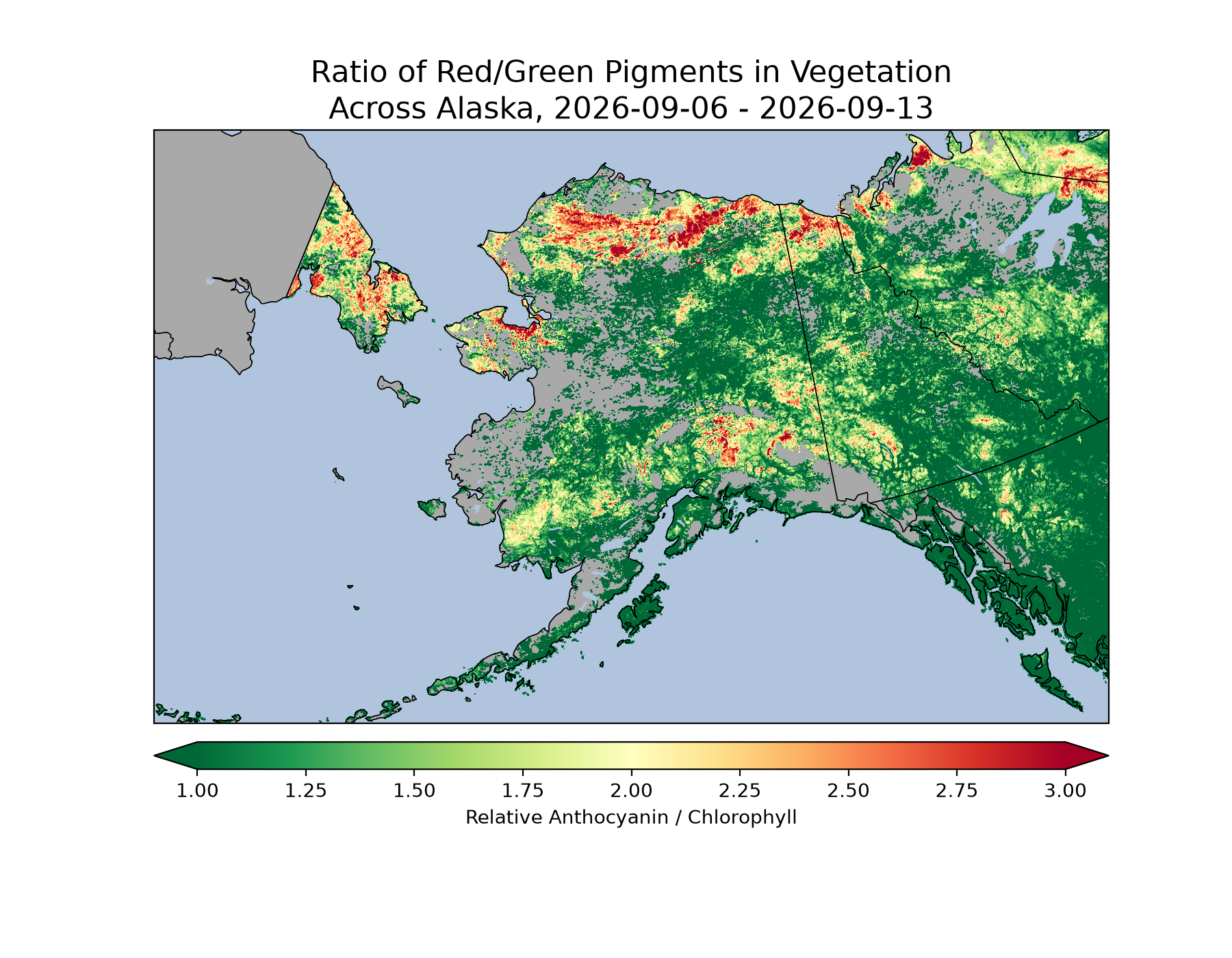
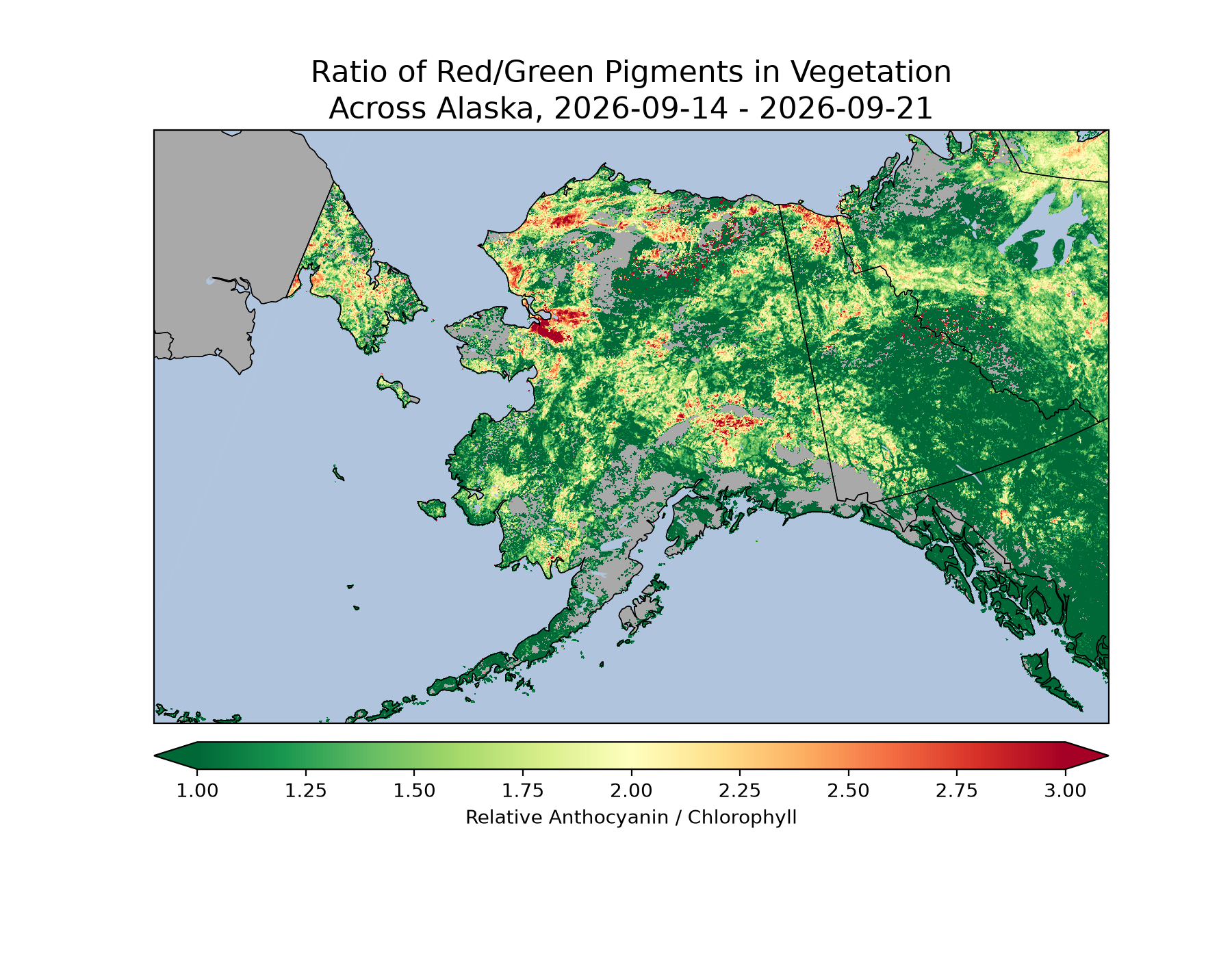
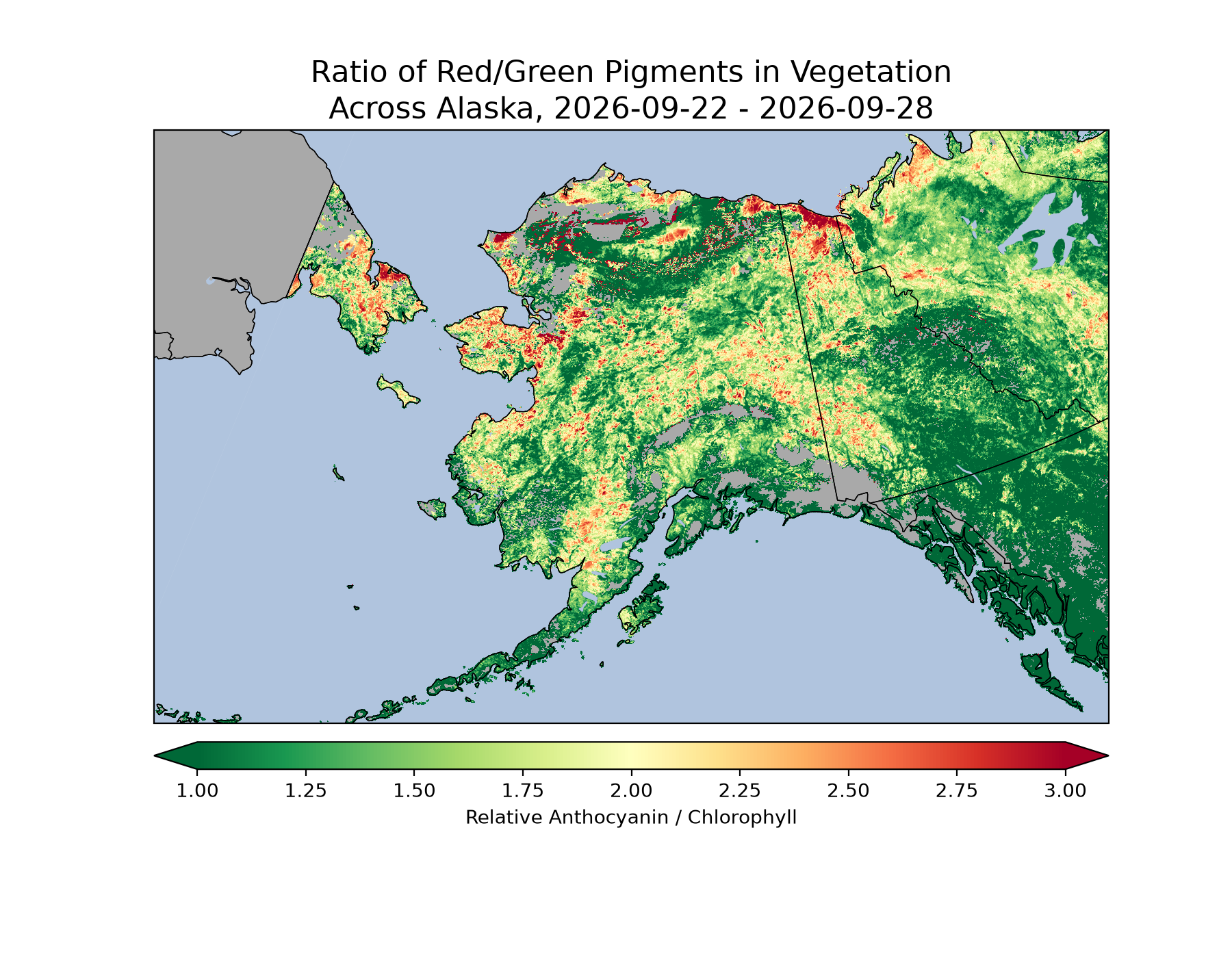
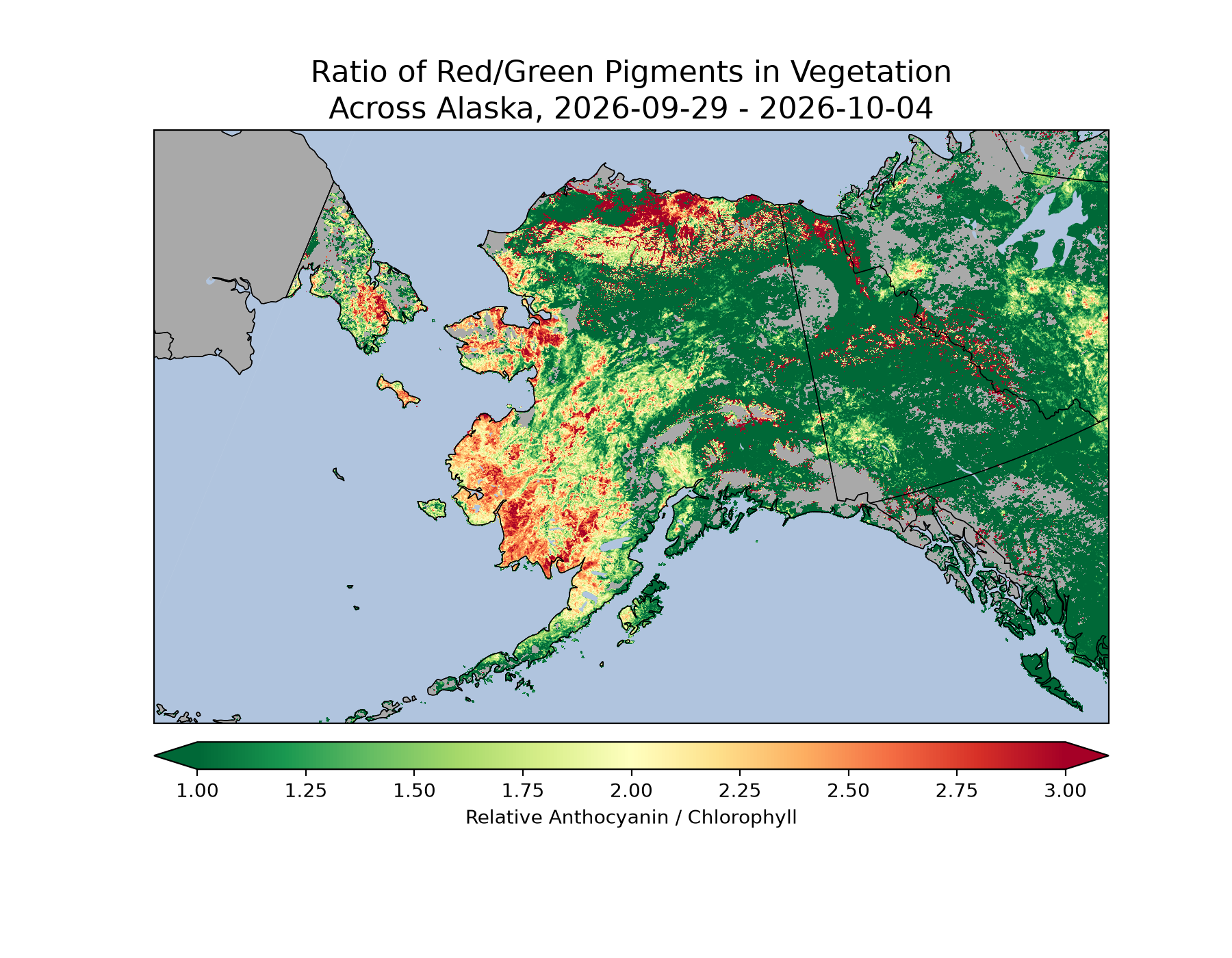
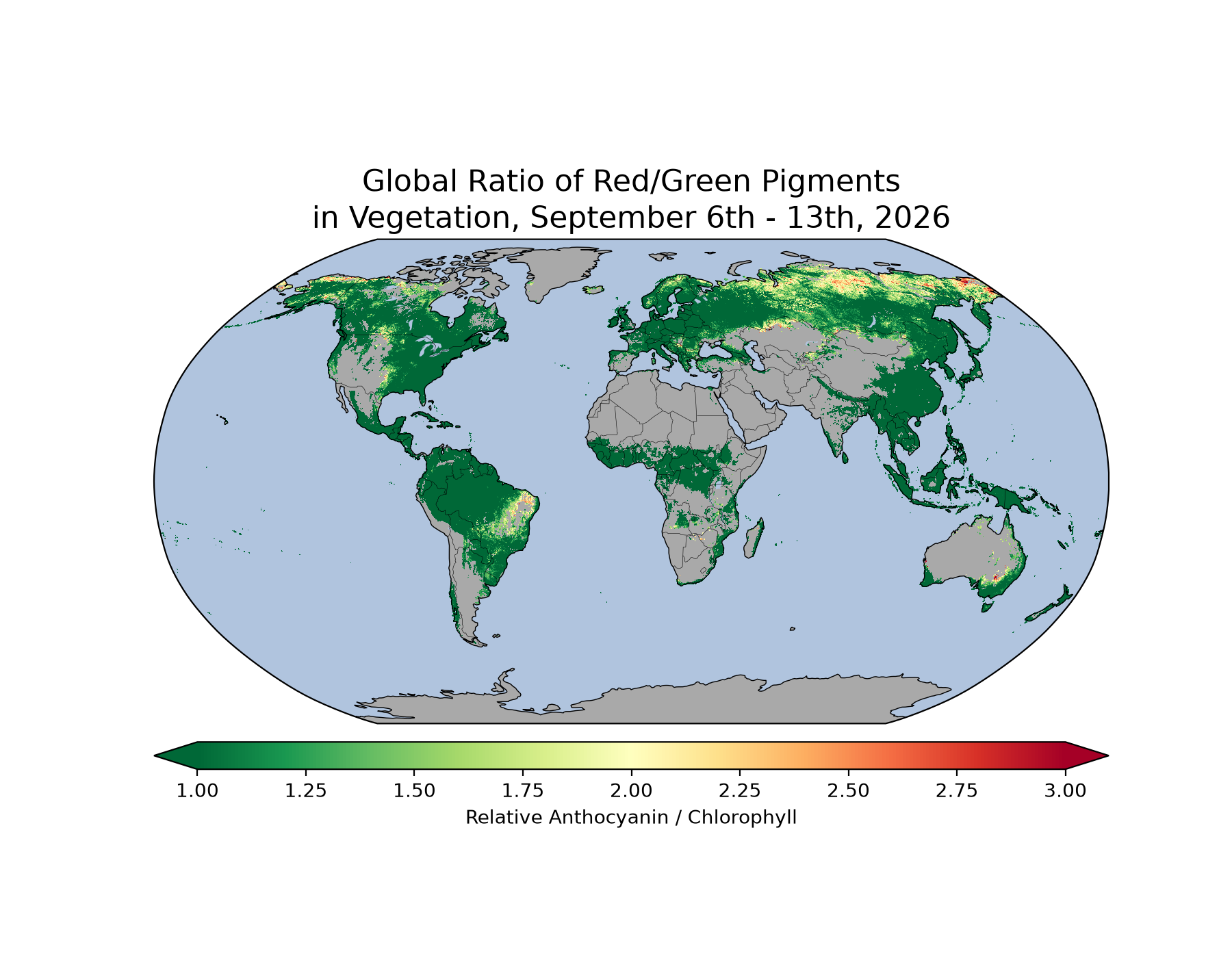
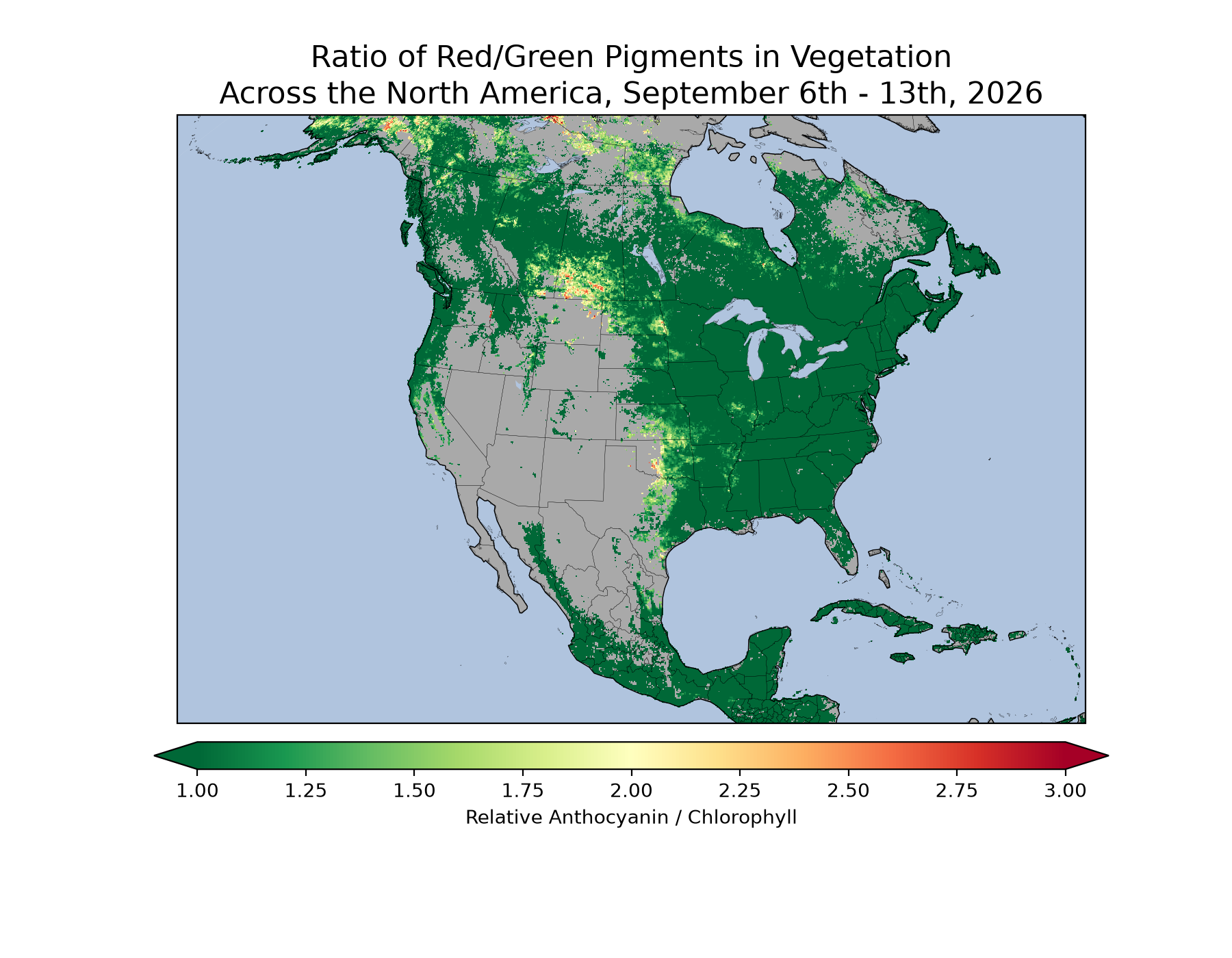
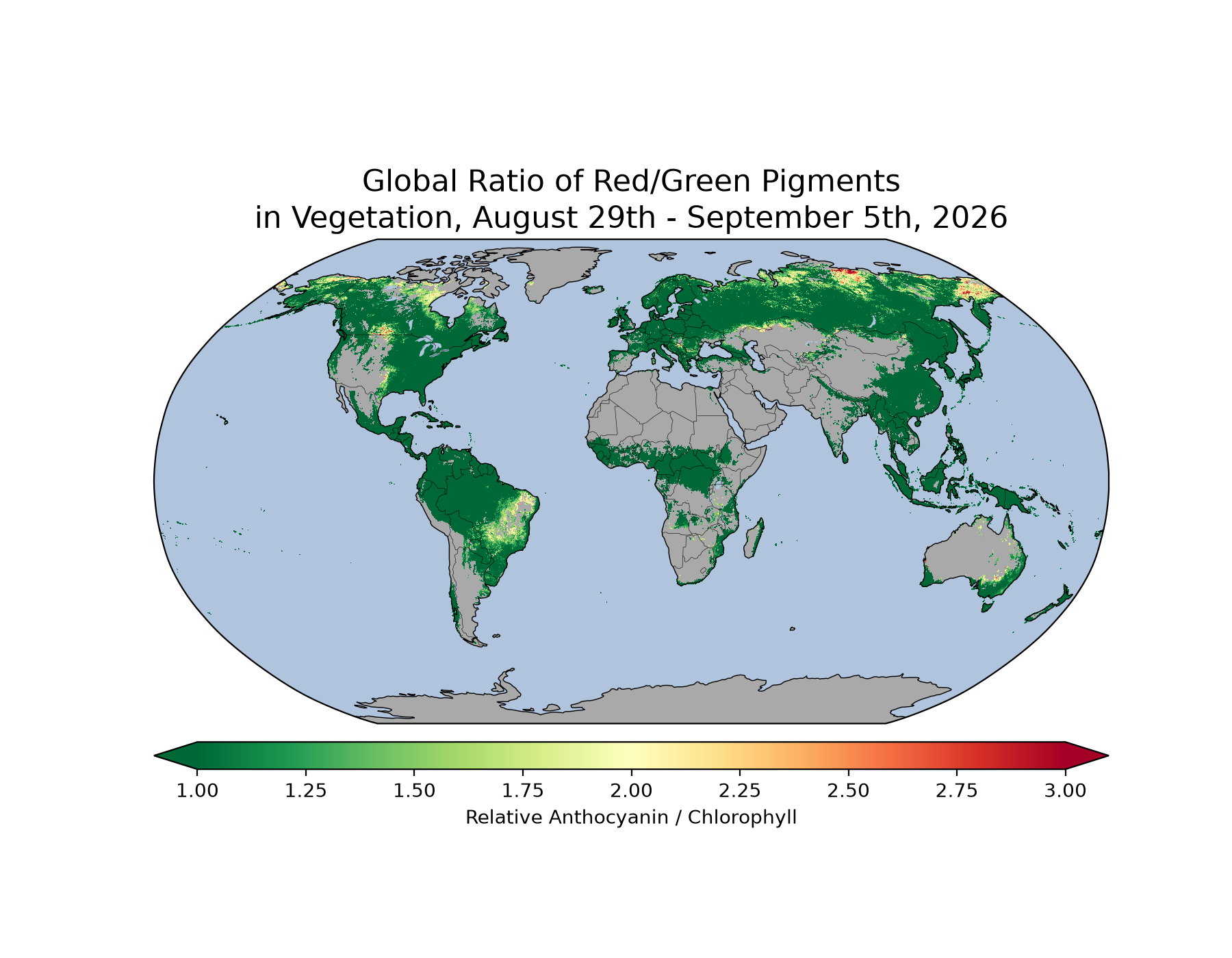
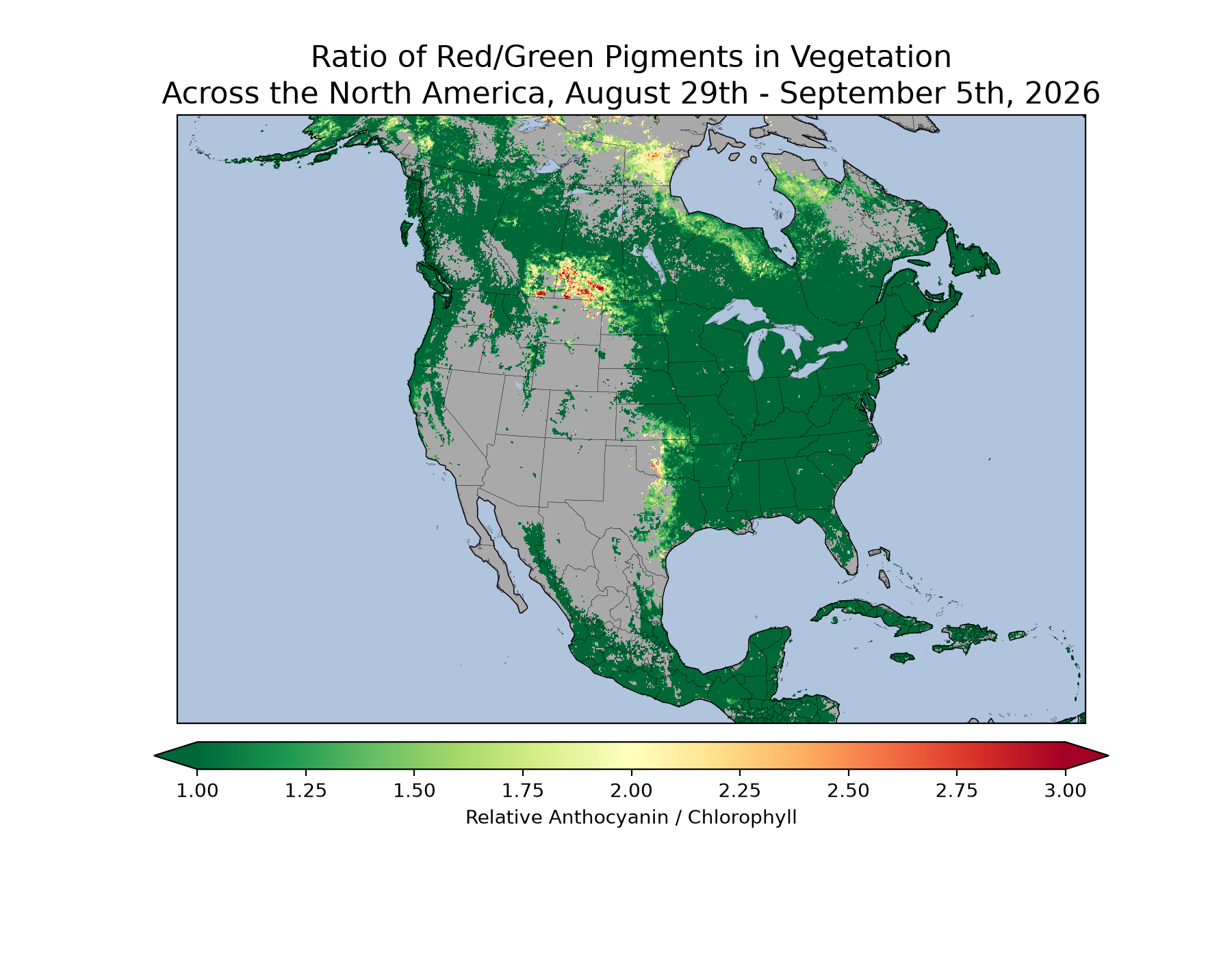
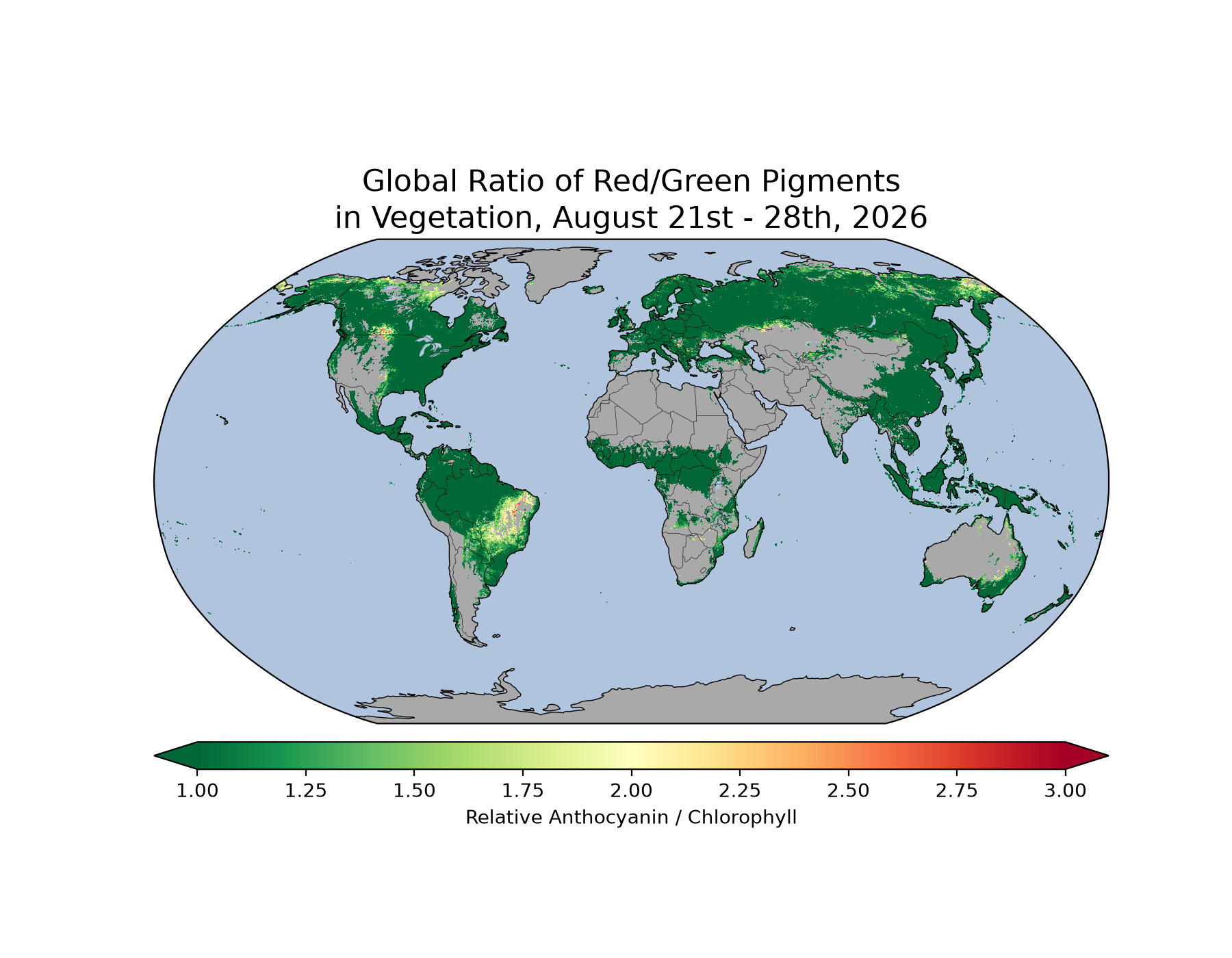
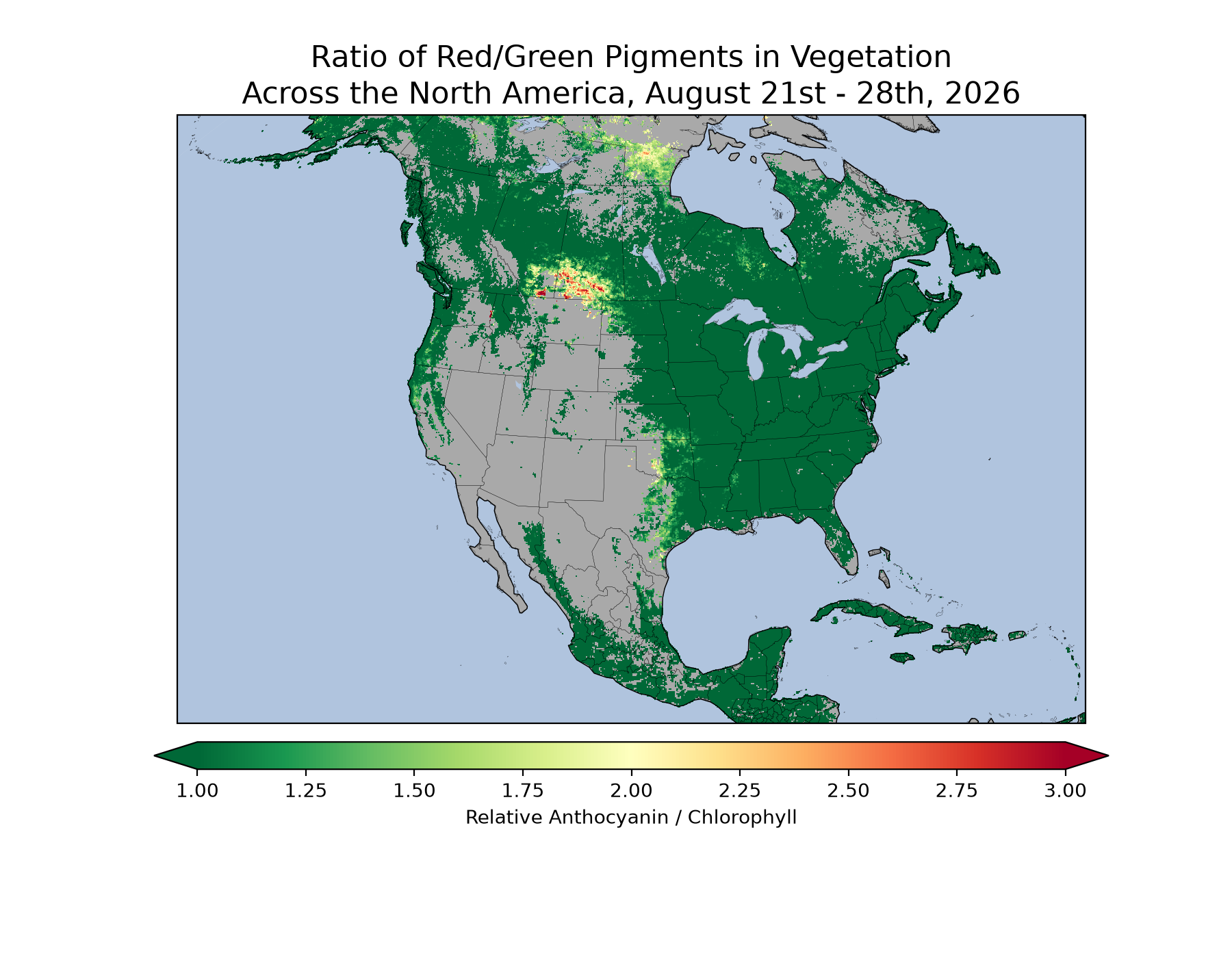
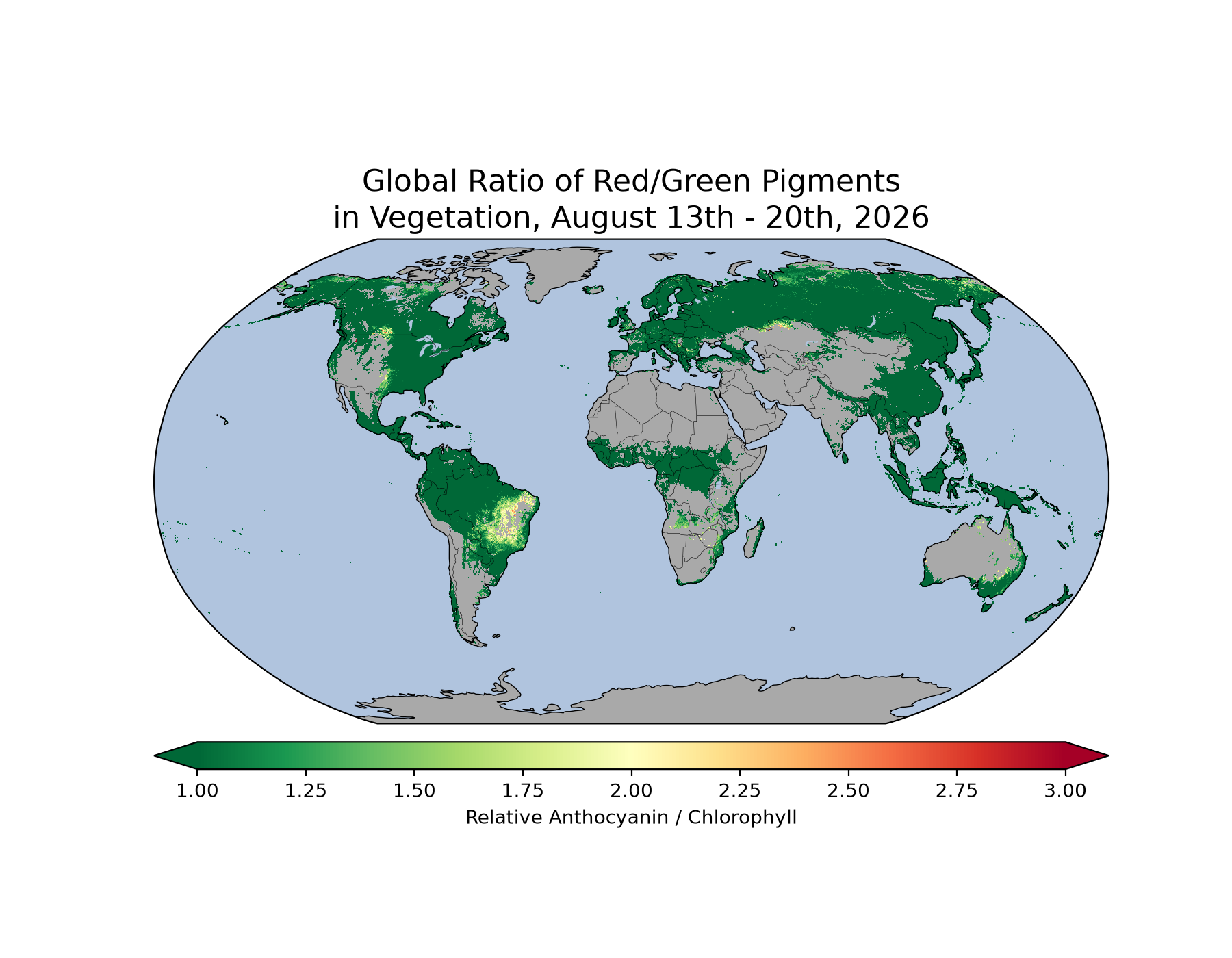
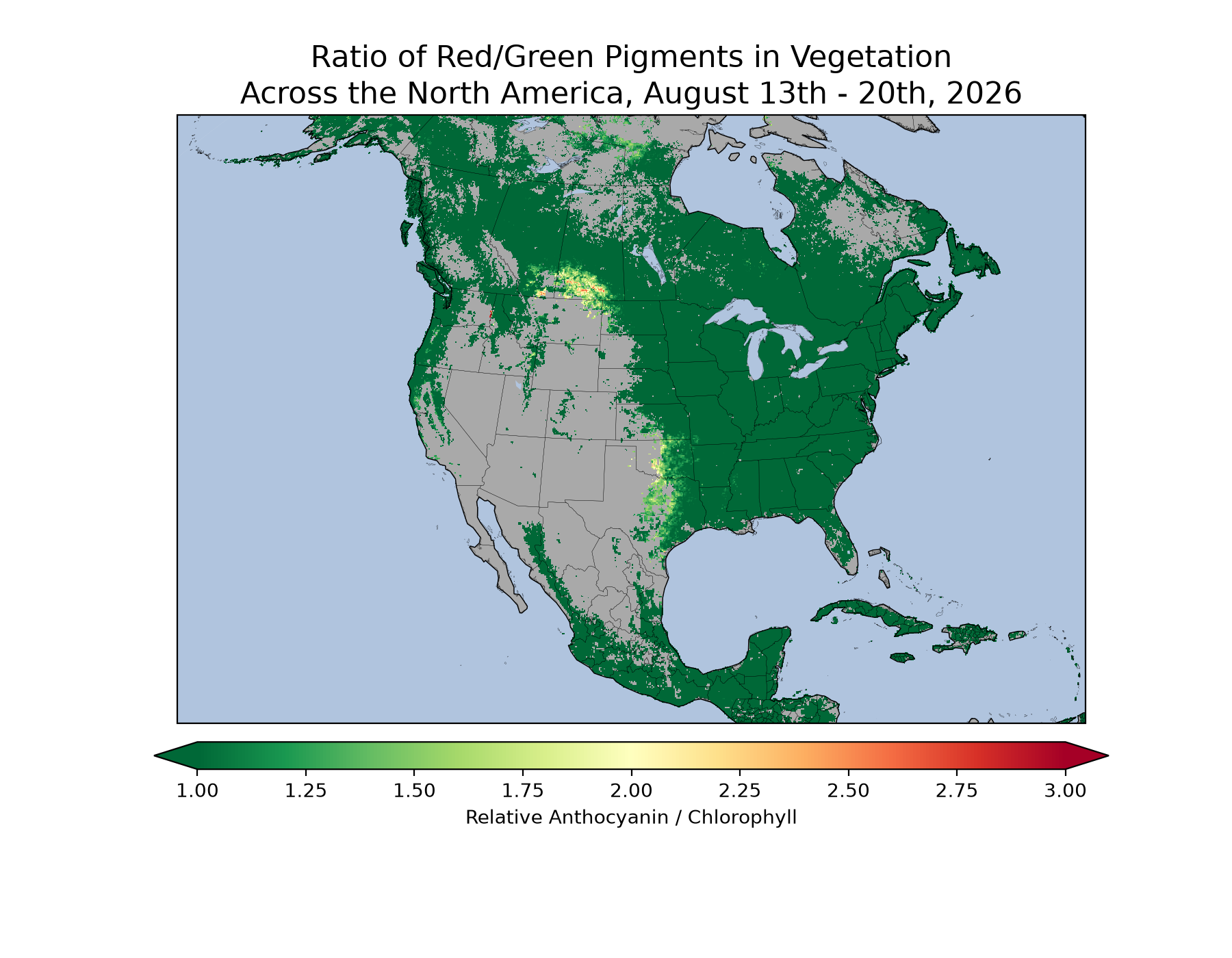
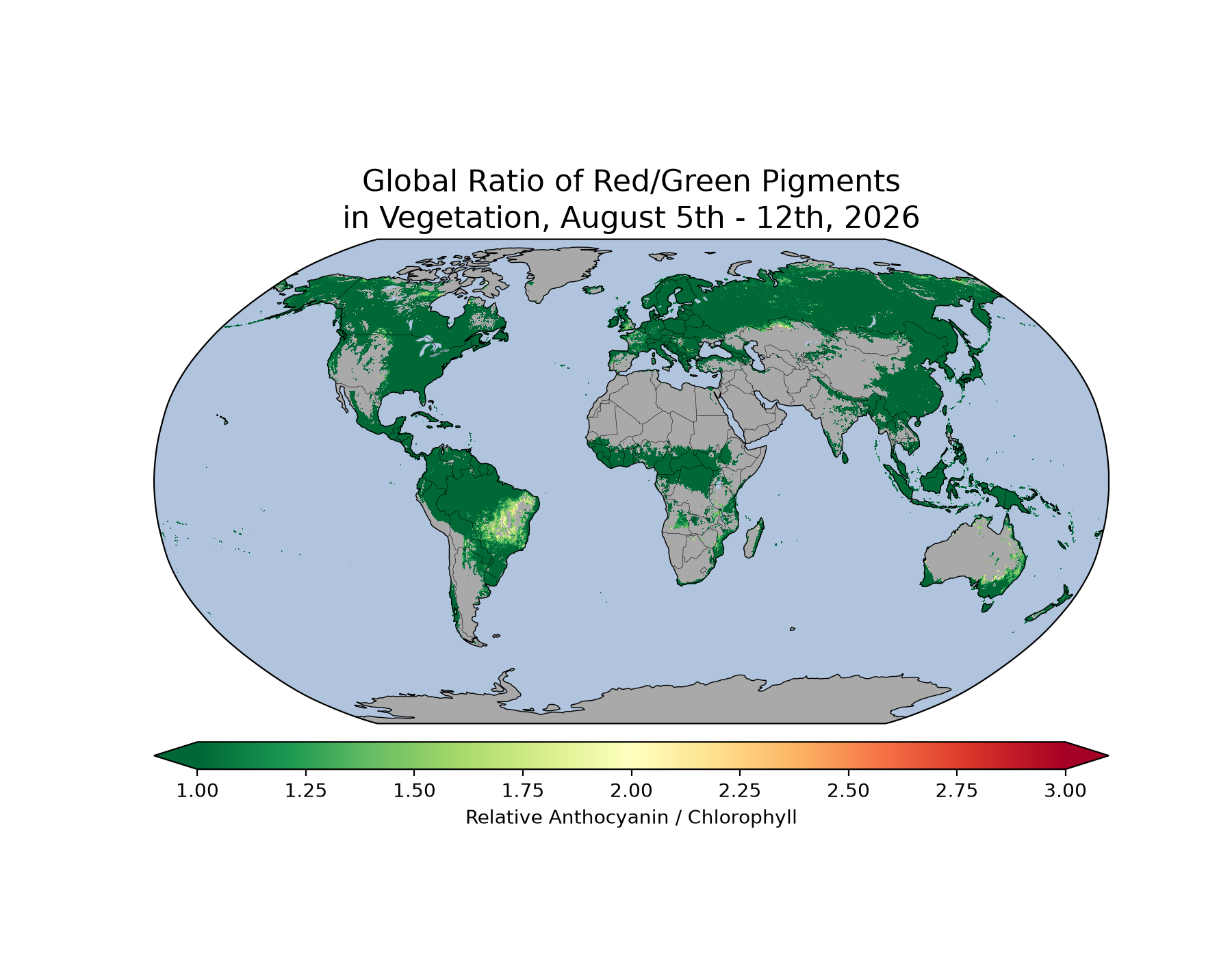
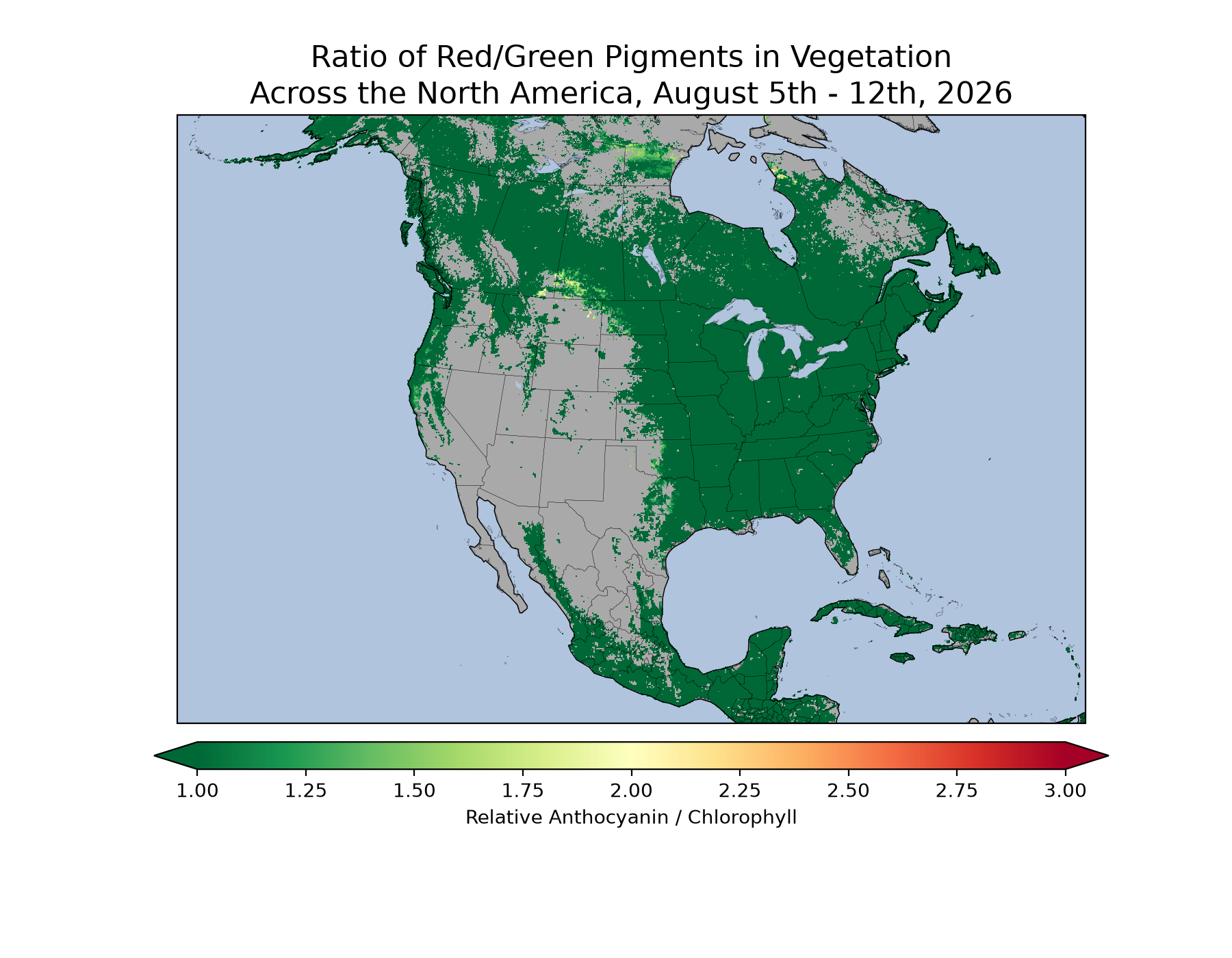
PACE uses reflected light at very specific wavelengths to capture the red (anthocyanin) and green (chlorophyll) pigments in plants. Those pigments can then be compared to assess which color is most dominant on a broad scale. Values close to 1, represented in green on the maps below, mean that the reds and greens are about even, while higher values, shown in yellow and red, mean that the leaves have relatively more red pigment than green. When enough reds overtake the greens, the leaves start to change color to the human eye, making them perfect for leaf peeping!
Note: Not all the yellows and reds on the map represent fall colors. For example, agricultural areas may show up with high anthocyanin values when crops are starting to senesce or after harvest. Some agricultural regions of Brazil appear in the maps in September, and the United States Midwest (the "corn belt") will start showing signs soon.
See the images below for global and North American region maps for weeks beginning in August 2026. Earlier maps are at the bottom of the page and more current maps will be added to the top of the page throughout the fall. Each week (starting with September 14-21) will include a summary of what is occurring on the map.
November 2nd-8th, 2026
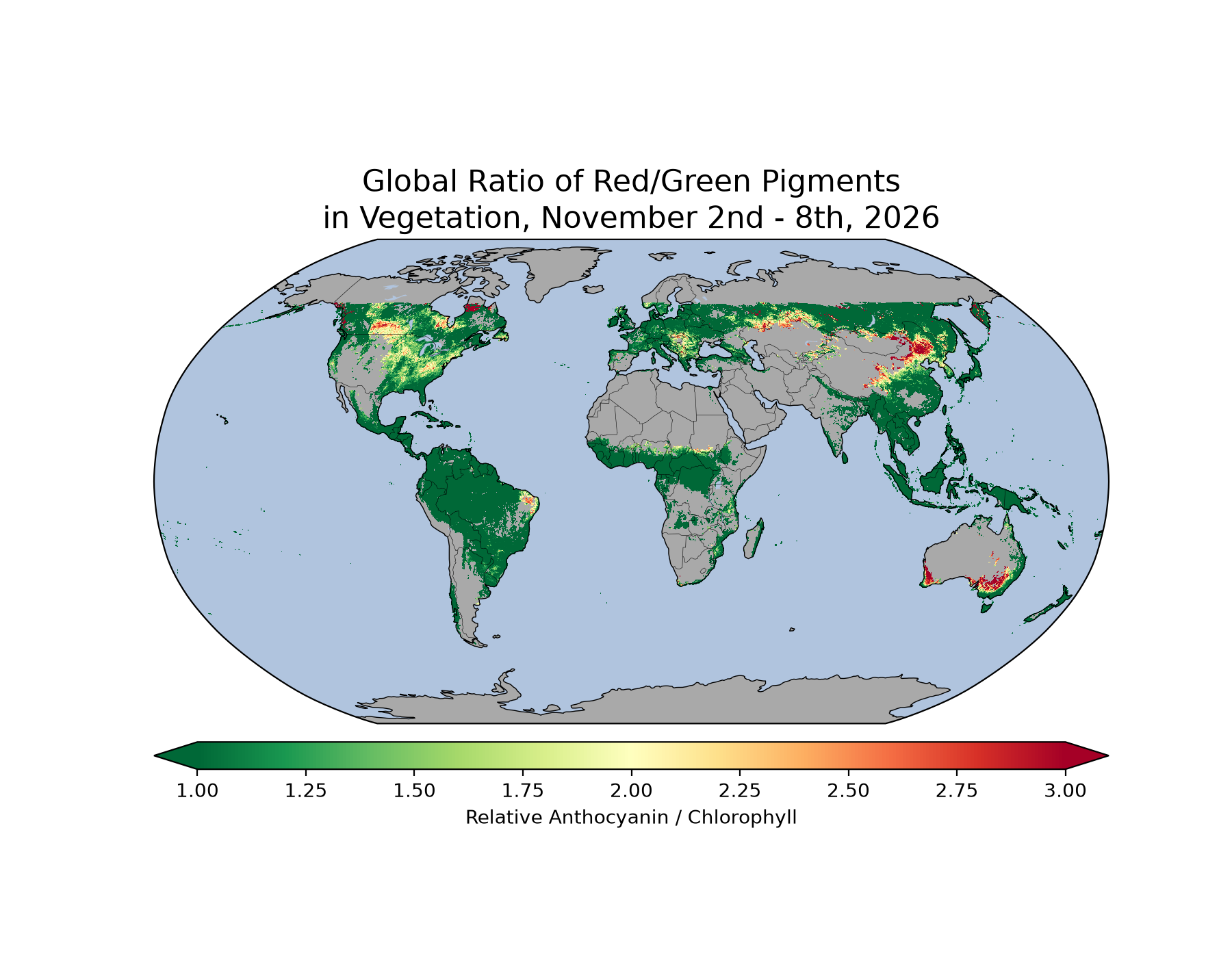
Similar to last week, areas in the Northern Hemisphere continue to see a decline in red/green pigment ratio values as these regions pass peak fall colour and the amount of anthocyanin and chlorophyll declines together. However, strong presence of anthocyanin can still be seen in North America in mountainous and agricultural regions. Central Europe continues to see a strong presence of anthocyanin, as do the forest steppe and mixed forests of southwestern Russia and the western steppes of China. Some of the anthocyanin signal in these areas could be due to ground plants like sphagnum mosses turning red and being seen by the satellite. We are also continuing to see less data at high latitudes due to low sun angle and, eventually, polar night. In the Southern Hemisphere, the savannas of southwest and southeast Australia are seeing very elevated anthocyanin values as the region transitions into the hot, dry summer season that is exacerbated by the current drought and strong El Niño (see note from October 19th - 25th). Expand November 2 global image.
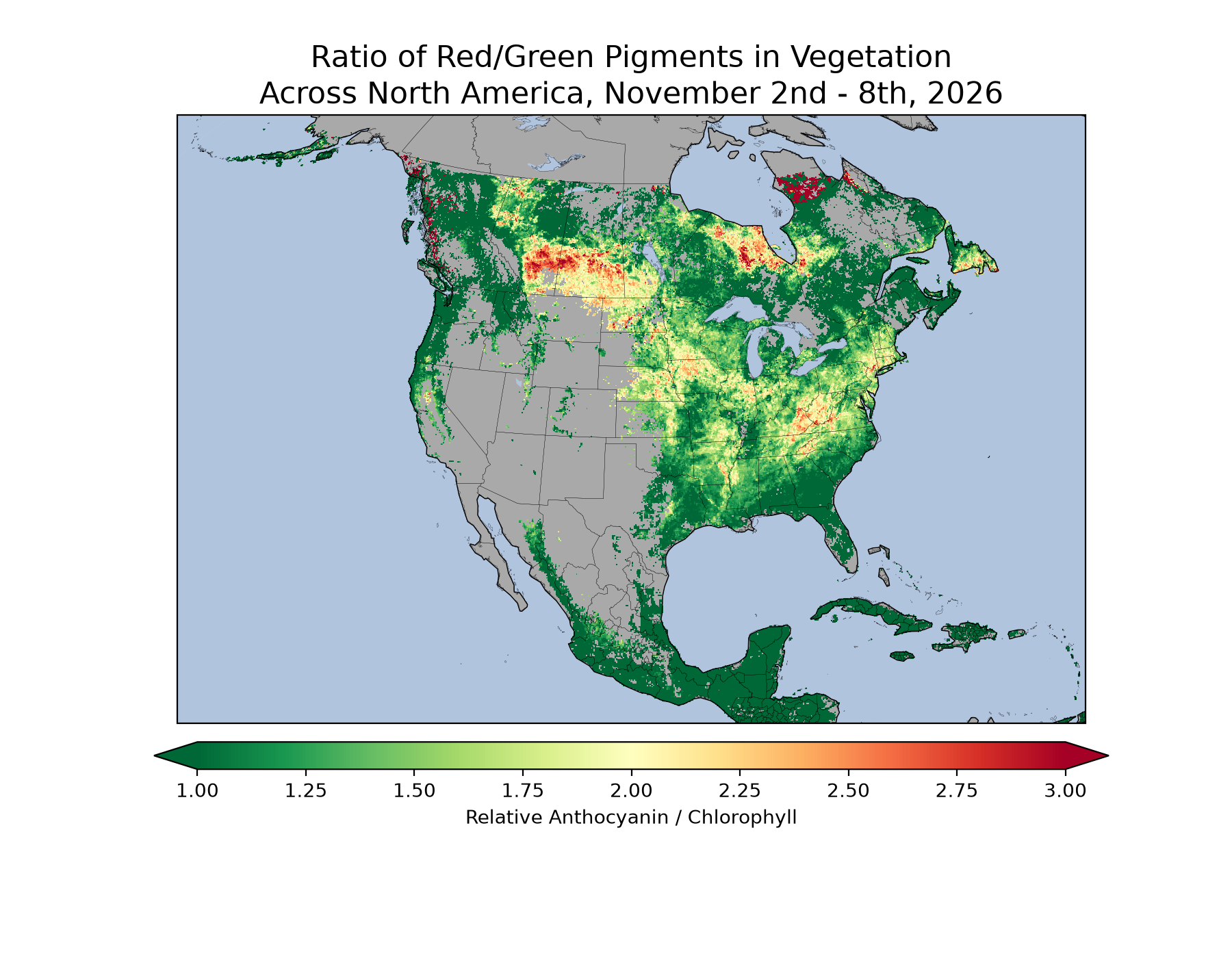
This week, from November 2–8, we can see widespread red pigment signal across the United States and Canada, with small relative amounts of anthocyanin beginning to show up in Mexico as well. Across the U.S. Southeast, red pigments seem to shift slightly west, although the high red/green ratio values are pretty stable compared to last week. The Appalachian Mountains, Hudson Bay Lowlands, and agricultural areas across the region all also have a continuous strong presence of anthocyanin. Some areas with lower values might look “greener” than the past couple weeks, which is likely due to a decrease in anthocyanin and chlorophyll together, resulting in pigment ratios closer to one. We can also see that almost all data from Alaska, Yukon, the Northwest Territories, and Nunavut have been filtered out due to low light conditions. Expand November 2 North America image.
October 26th-November 1st, 2026
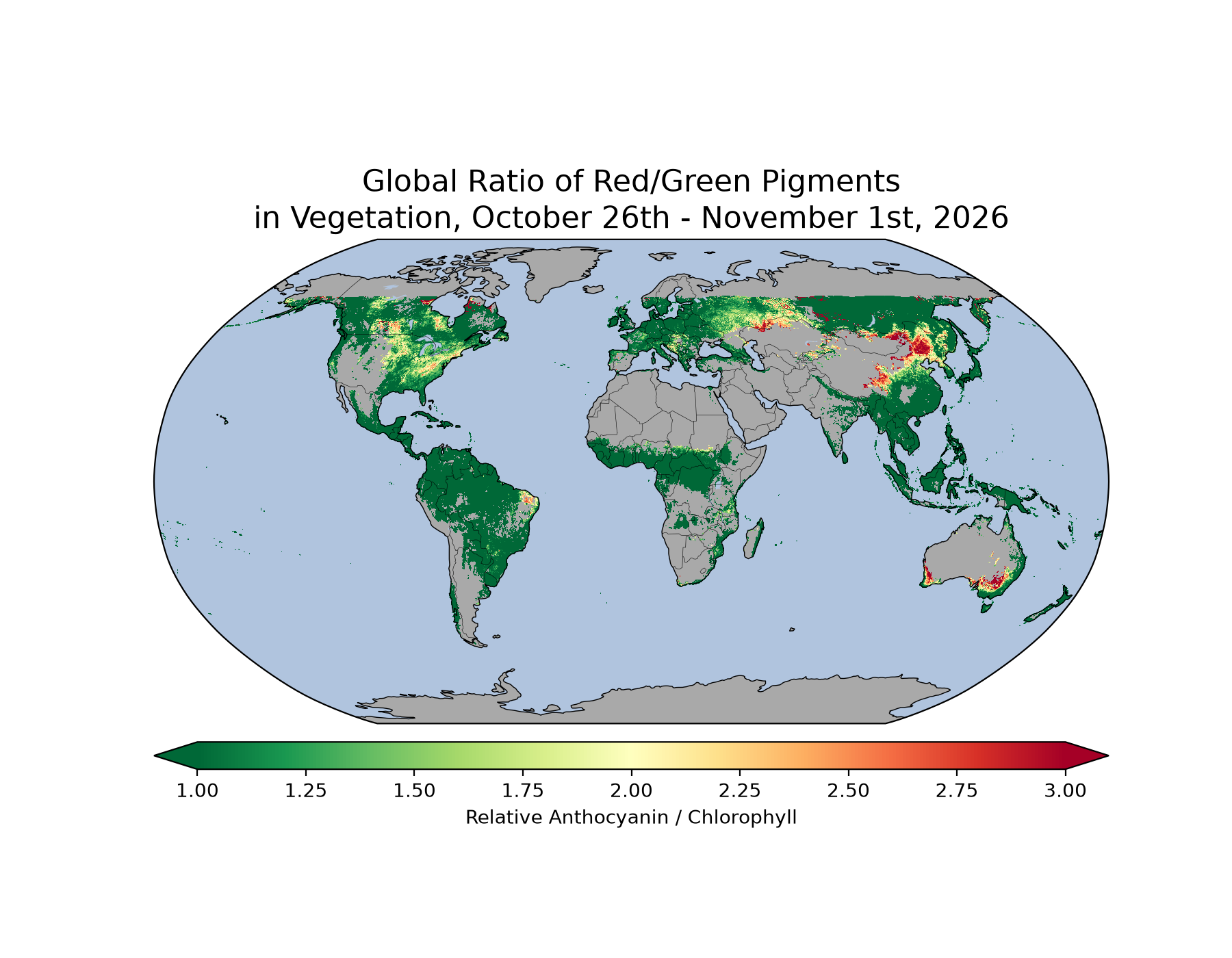
Many areas across the globe are seeing decreases in red/green pigment ratio values, likely as the time of peak color has passed and anthocyanin and chlorophyll presence is declining together. However, strong presence of anthocyanin can still be seen in North America in the Appalachian Mountains and across the Midwest. The Hudson Bay Lowlands and across the Atlantic in Western Siberia are also seeing sustained anthocyanin signals, possibly due to ground plants like sphagnum mosses turning red and being seen by the satellite. We are also continuing to see less data at high latitudes due to low sun angle and, eventually, polar night. Expand October 26 global image.
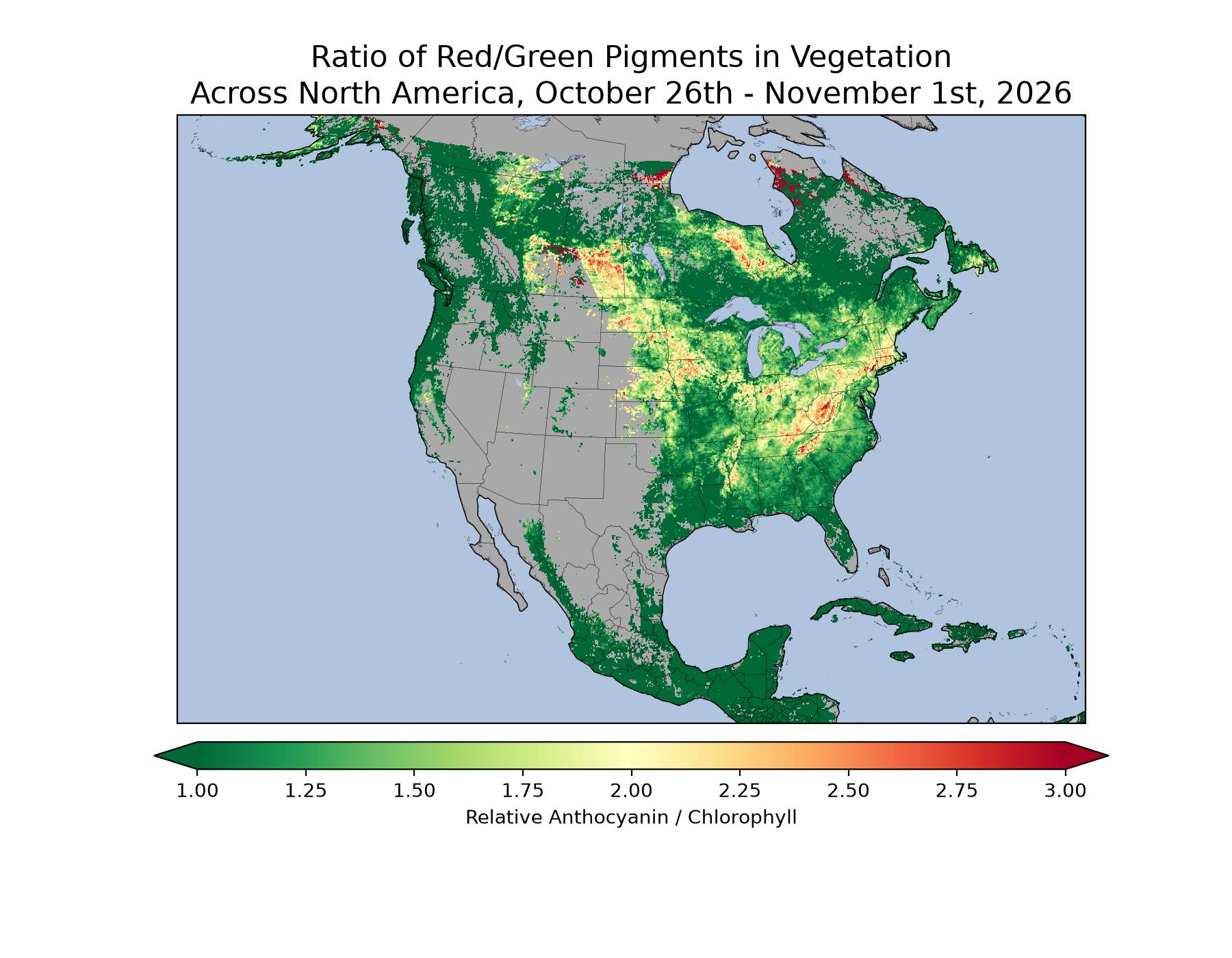
This week, from October 26–November 1, we can see widespread red pigment signal across the United States and Canada, with small relative amounts of anthocyanin beginning to show up in Mexico as well. The Appalachian Mountains continue to show strong signal as they reach and pass peak color. The Hudson Bay Lowlands also have a continuous strong presence of anthocyanin, which could be attributed to ground plants, like sphagnum mosses, changing color and staying red. Some areas with lower values might look “greener” than the past couple weeks, which is likely due to a decrease in anthocyanin and chlorophyll together, resulting in pigment ratios closer to one. Expand October 26 North America image.
October 19th-25th, 2026
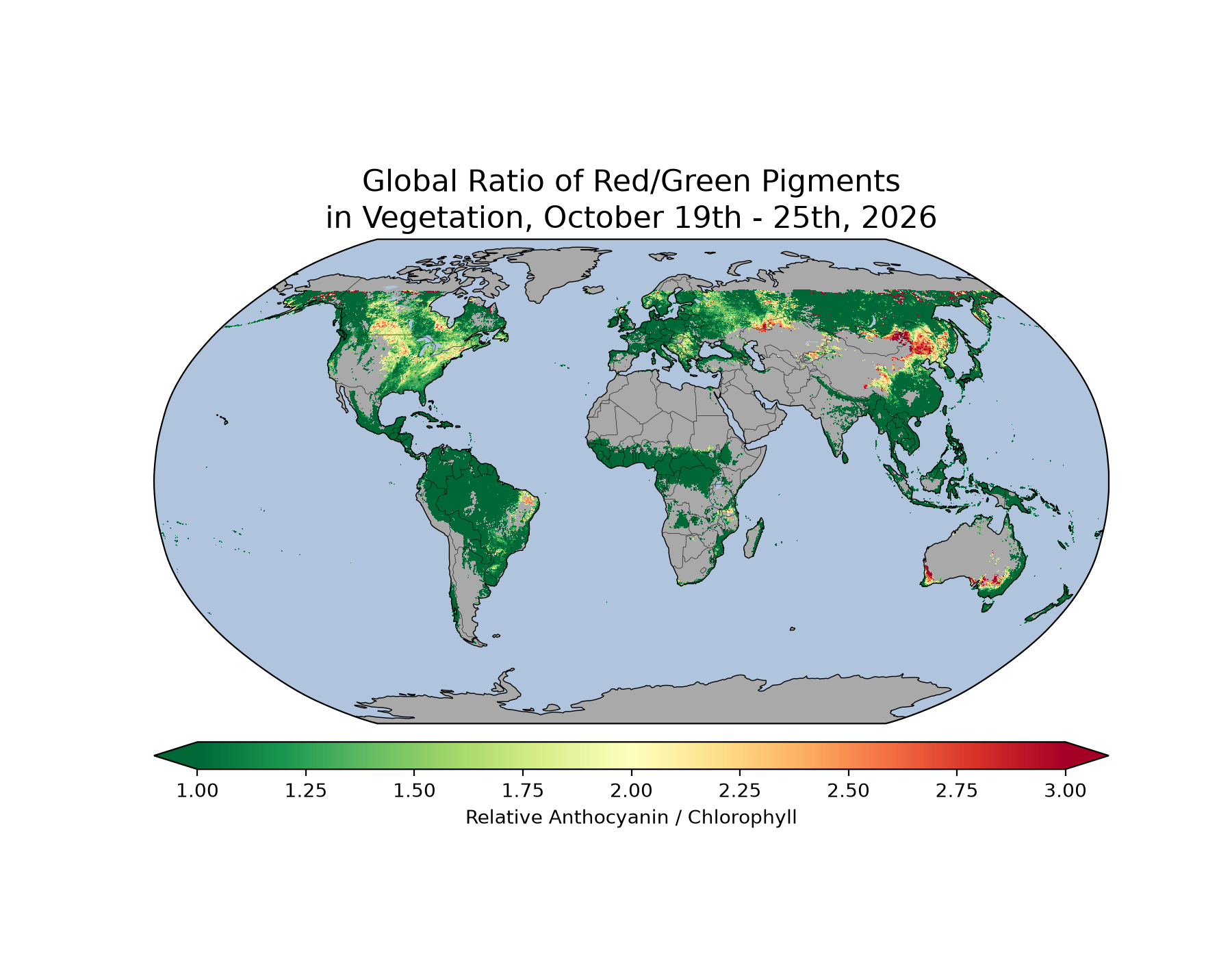
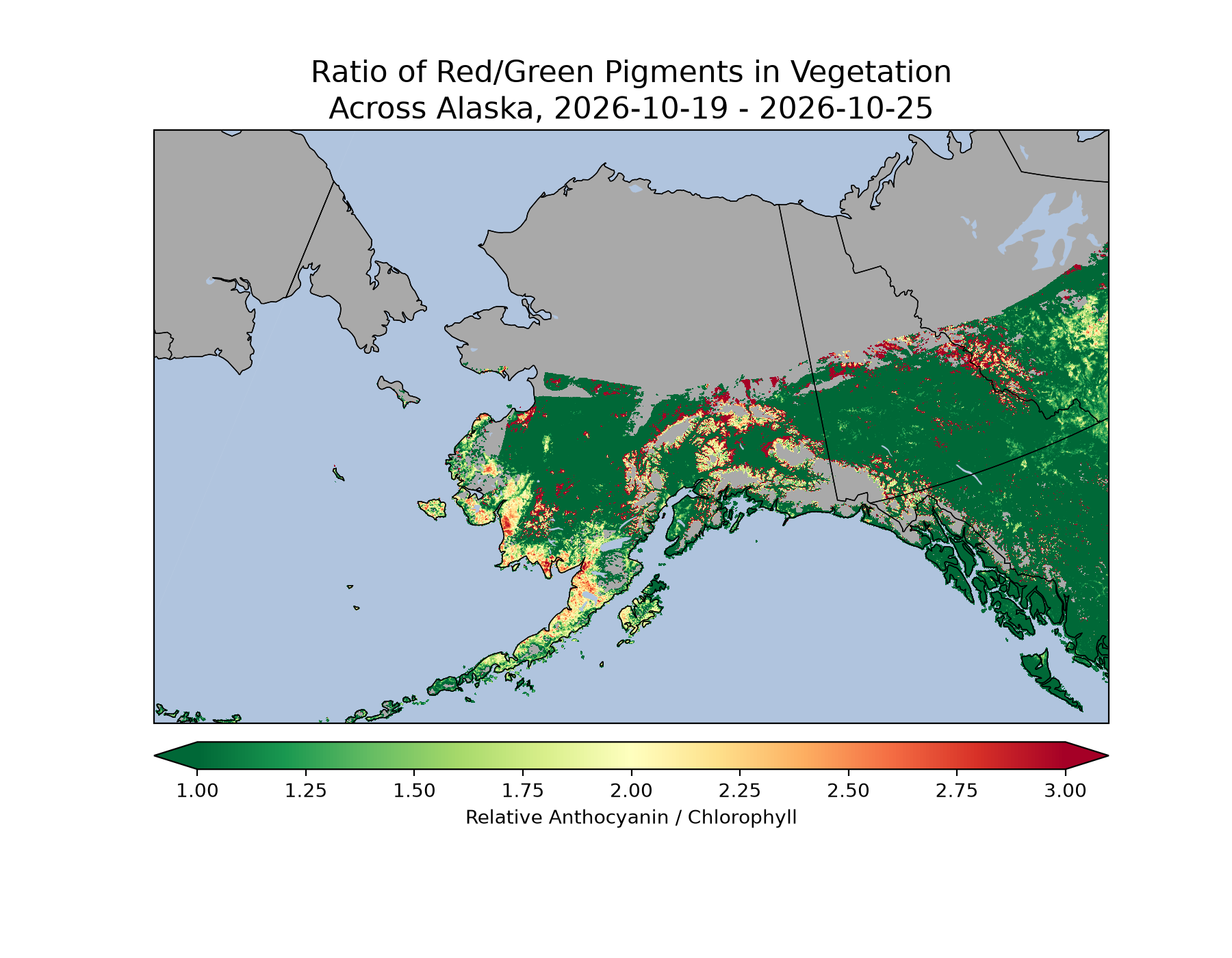
Globally, most of the northern hemisphere is showing high relative redness. North America in particular has elevated anthocyanin levels, with the pigment appearing across forested and agricultural areas of the Southeast, Canada, and Alaska. Compared to last week, the red pigment in the Ural Mountains has decreased, likely due to loss of leaves and needles in the region. Central European mixed forests, by contrast, are showing up more brightly with red pigment this week. The steady, strong presence of anthocyanin remains in northeastern China and parts of Mongolia. The Greater Khingan, Lesser Khingan, and Changbai mountains in northeastern China have mixed deciduous-conifer forests that include birches, oaks, maples, spruces, and larches, which are now near peak color. (This area is also the original range of the Siberian tiger.) Anthocyanin is decreasing in the Caatinga region in northeastern Brazil. We are also continuing to see less data at high latitudes due to low sun angle and, eventually, polar night. Expand October 19 global image.
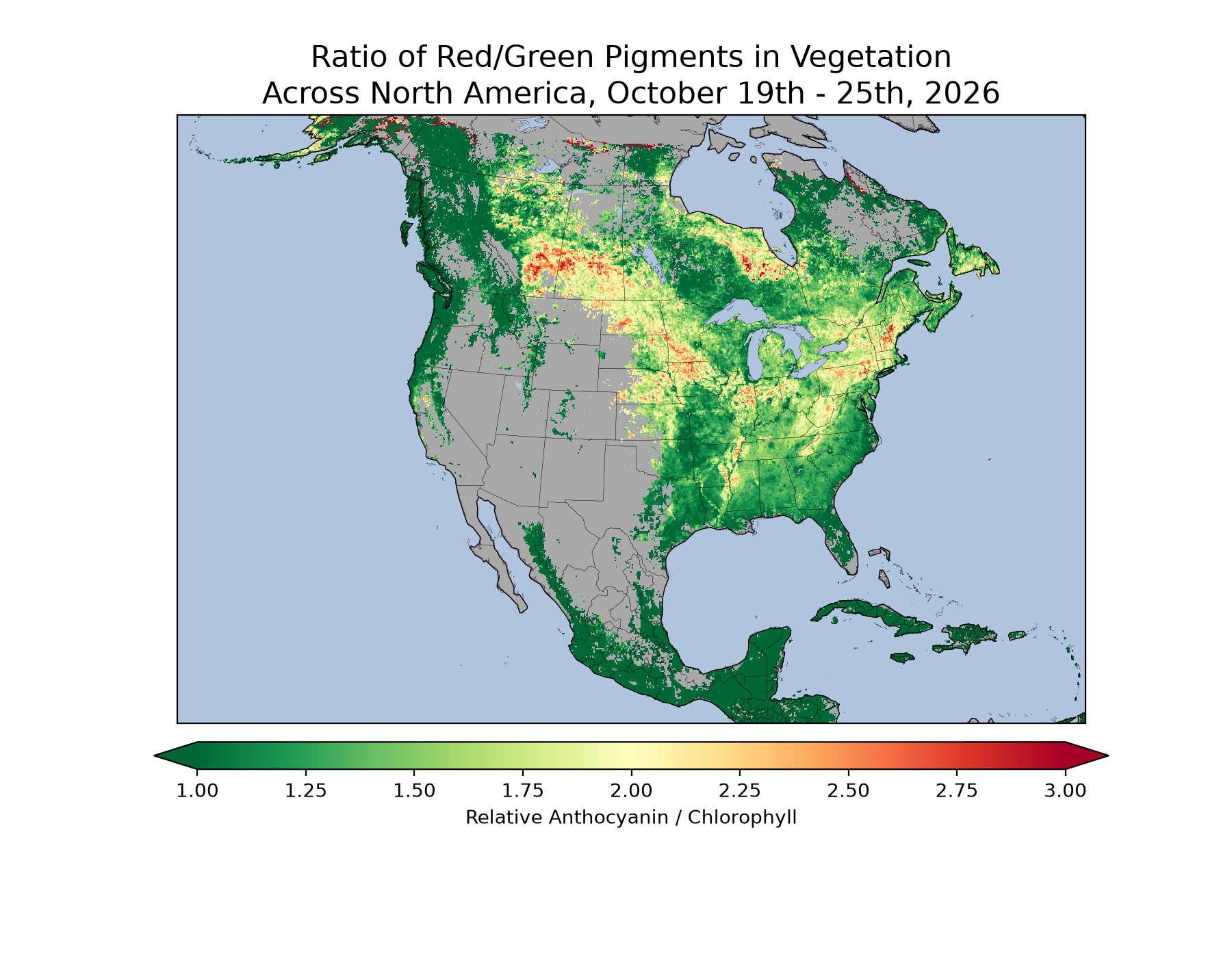
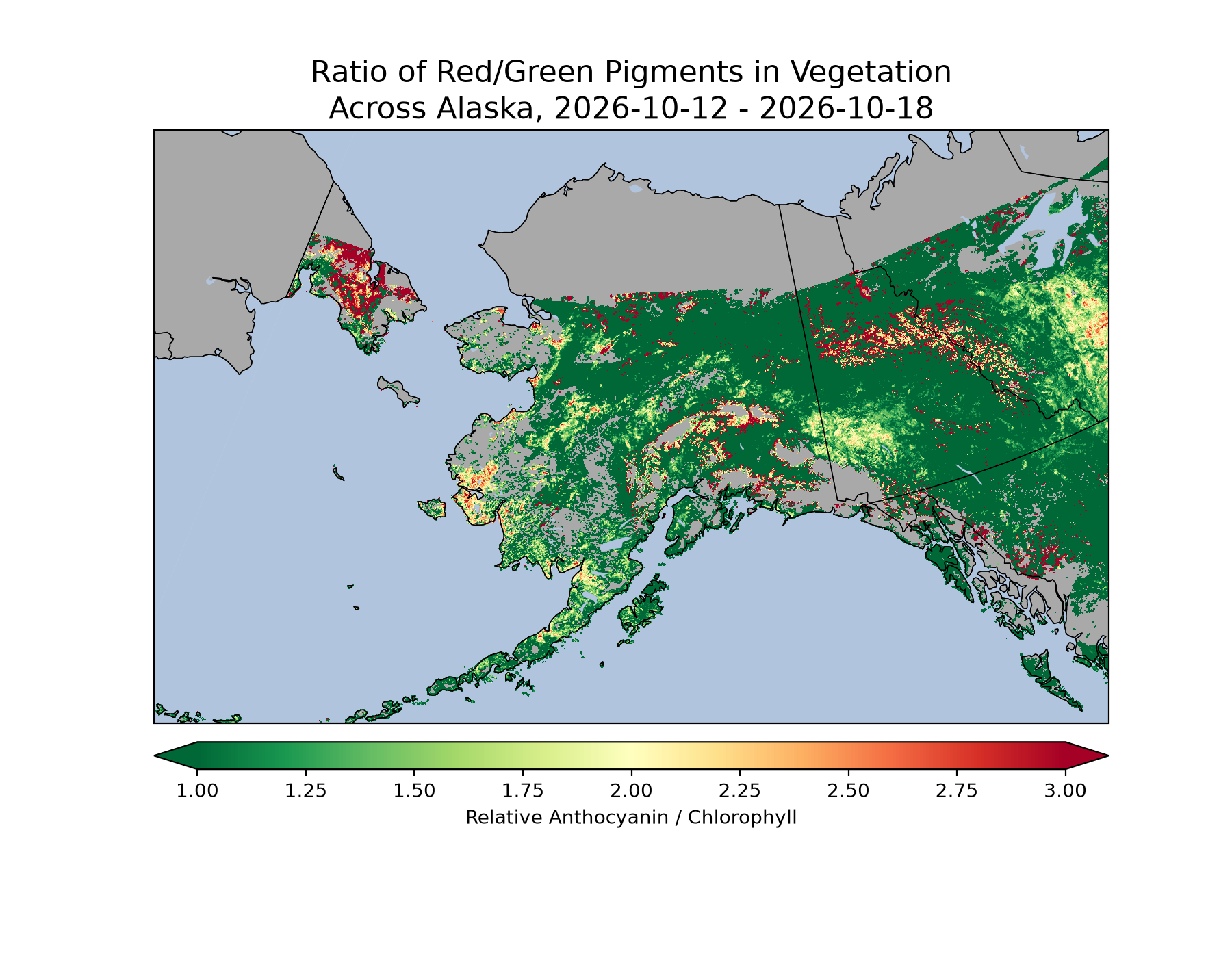
This week, from October 19–25, we can see a sustained and strong presence of red pigments throughout the United States and Canada. Almost all of the vegetated areas across the two countries show some elevated level of anthocyanin relative to chlorophyll, indicating that autumn is in full swing. The Appalachian Mountains are showing particularly high relative red pigment levels, along with the typical signals from agricultural areas in Canada and the Midwest. Farther north, the Alaskan Peninsula and southwest coast appear to be turning red as well. Like last week, many mountainous regions in the Northeast and around the Hudson Bay continually show high relative redness; some of this response may be due to the presence of soil in an image, now that trees have lost some or most of their leaves. Expand October 19 North America image.
An extra note about the global map for October 19-25
The Southwest Australia Savanna ecoregion shows up as a thin wedge of red in southwest Australia. This region is eucalyptus woodland, savanna, and shrublands. The climate has cool wet winters that transition into hot dry summers. Generally, this time of year (southern hemisphere spring) is an important growth period as there is water in the ground from the winter rains and the temperatures warm up. Often there are lots of wildflowers blooming this time of year. However, western Australia is in a drought with very little winter rainfall resulting in deep soil moisture deficits, coupled with unseasonably hot temperatures that is increasing evapotranspiration. This is causing significant plant stress in this ecoregion. These dry conditions are due to the El Niño, which causes warmer and drier conditions in this region.
October 12th-18th, 2026
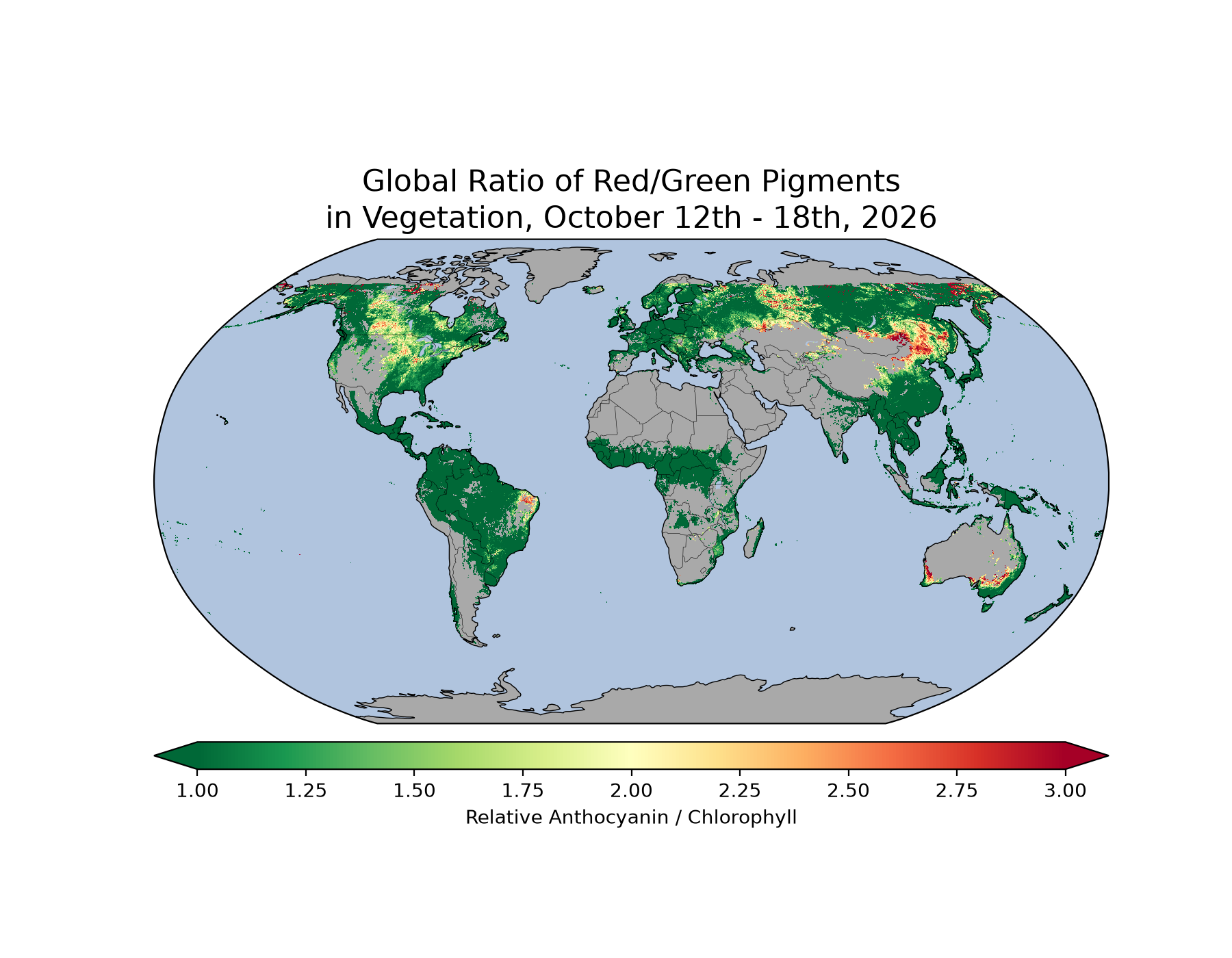
Globally, areas across the northern hemisphere continue to see a growing or sustained presence of red pigments. North American forests and agricultural areas are bright on this week's maps, with anthocyanin showing up even into the southeast. The Ural Mountains and West Siberian Plains show strong anthocyanin signals, along with northeastern China and parts of Mongolia. European countries are also seeing low level red pigments show up in Scotland, the Balkans, and the Nordic countries. The Caatinga region in northeastern Brazil, starting its summer dry season, continues to show a high ratio of anthocyanin to chlorophyll. We are also starting to see less data at high latitudes due to low sun angle and, eventually, polar night. Expand October 12 global image.
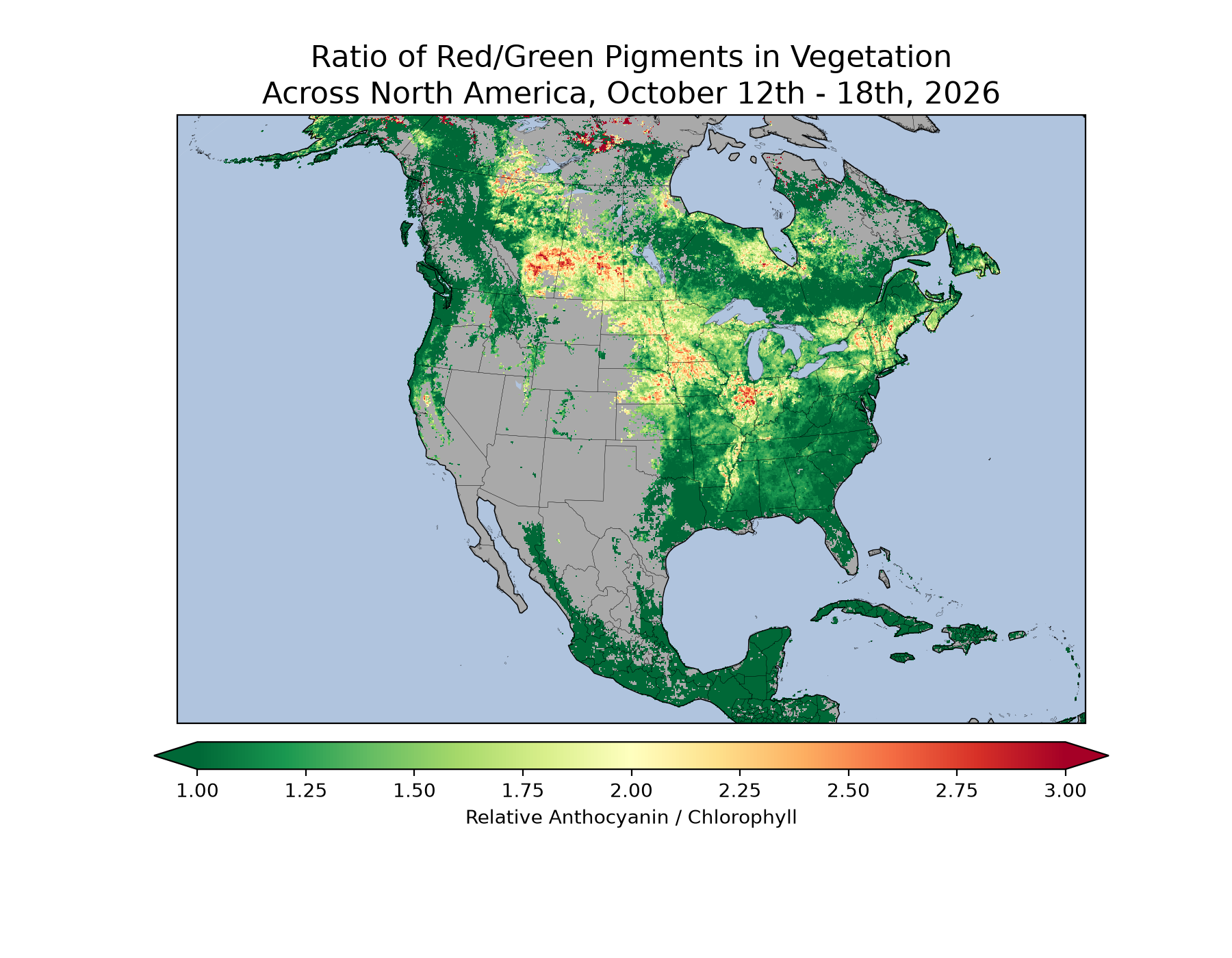
This week, from October 12–18, we can see a blooming of red pigments throughout the United States and Canada, with red pigments overtaking green even into some of the southeastern states like Georgia and Alabama. The corn belt in the Midwest and the Canadian plains continue to show strong anthocyanin signals. The boreal forests of Alberta into the Northwest Territories and the western Yukon are all highlighted with red pigment this week as well. The Hudson Bay Lowlands, mountainous regions of the northeast, and the Alleghany Plateau are all likely past peak fall colors, but are still showing high relative red pigment amounts; some of this response may be due to soil showing up in the background, now that trees have lost some or most of their leaves. Expand October 12 North America image.
October 5th-11th, 2026
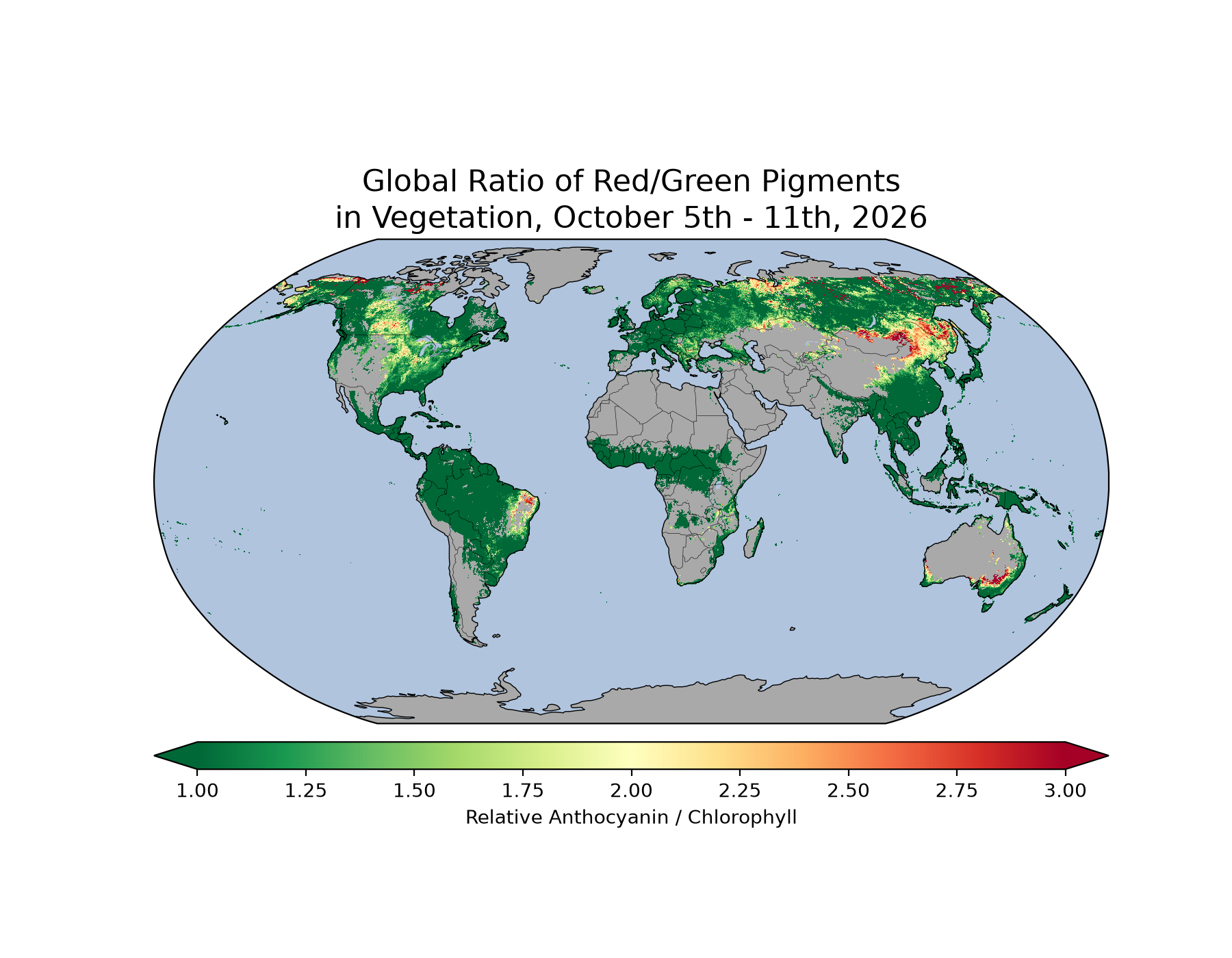
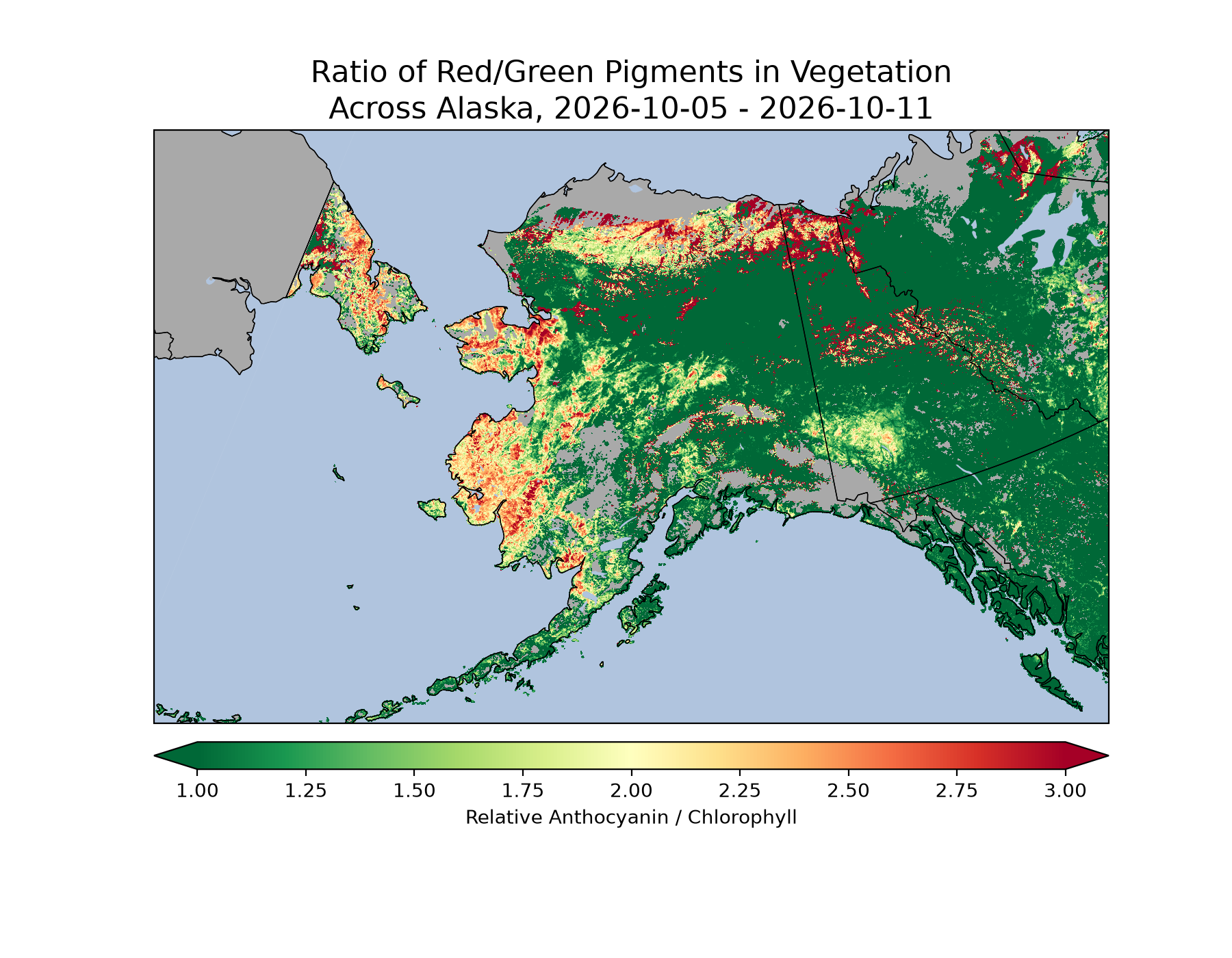
Globally, red pigment continues to be present across all of Russia and northeastern China, as well as Northern Europe and North America. Alaska in particular is seeing a strong anthocyanin signal along its west and north coasts. Compared to last week, pigment signals have slightly decreased as peak color passes in the highest latitudes and trees lose their needles and leaves. In the southern hemisphere, we see a strong red over green signal from the Caatinga region in northeastern Brazil. This area is currently entering their summer months and would not be exhibiting fall colors. The high values of the pigment ratio are likely a response to the dry season the region is currently experiencing. Expand October 5 global image.
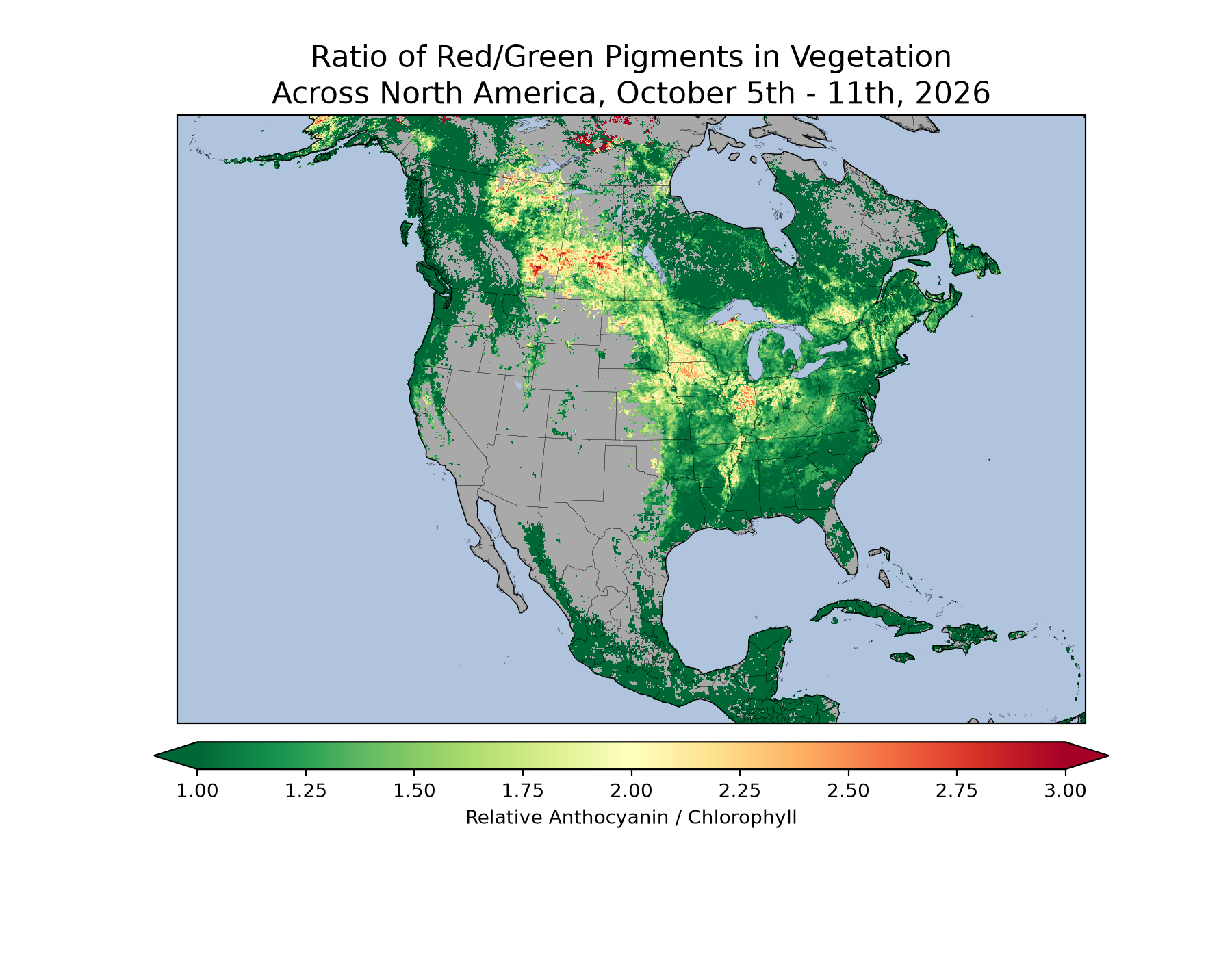
This week, from October 5–11, we can see that red pigments are intensifying across the Canadian Plains, the Midwest, and the eastern part of North America. In contrast to last week, the hotspots of pigment in the mountainous Northeast have reduced as trees in the region lose their leaves and the pigment signals lessen. In the Midwest, anthocyanin signal is starting to stand out, especially in the Upper Peninsula of Michigan and along the corn belt in states like Illinois and Iowa. Alberta and Saskatchewan continue to see high anthocyanin signals as well. Expand October 5 North America image.
September 29th-October 4th, 2026
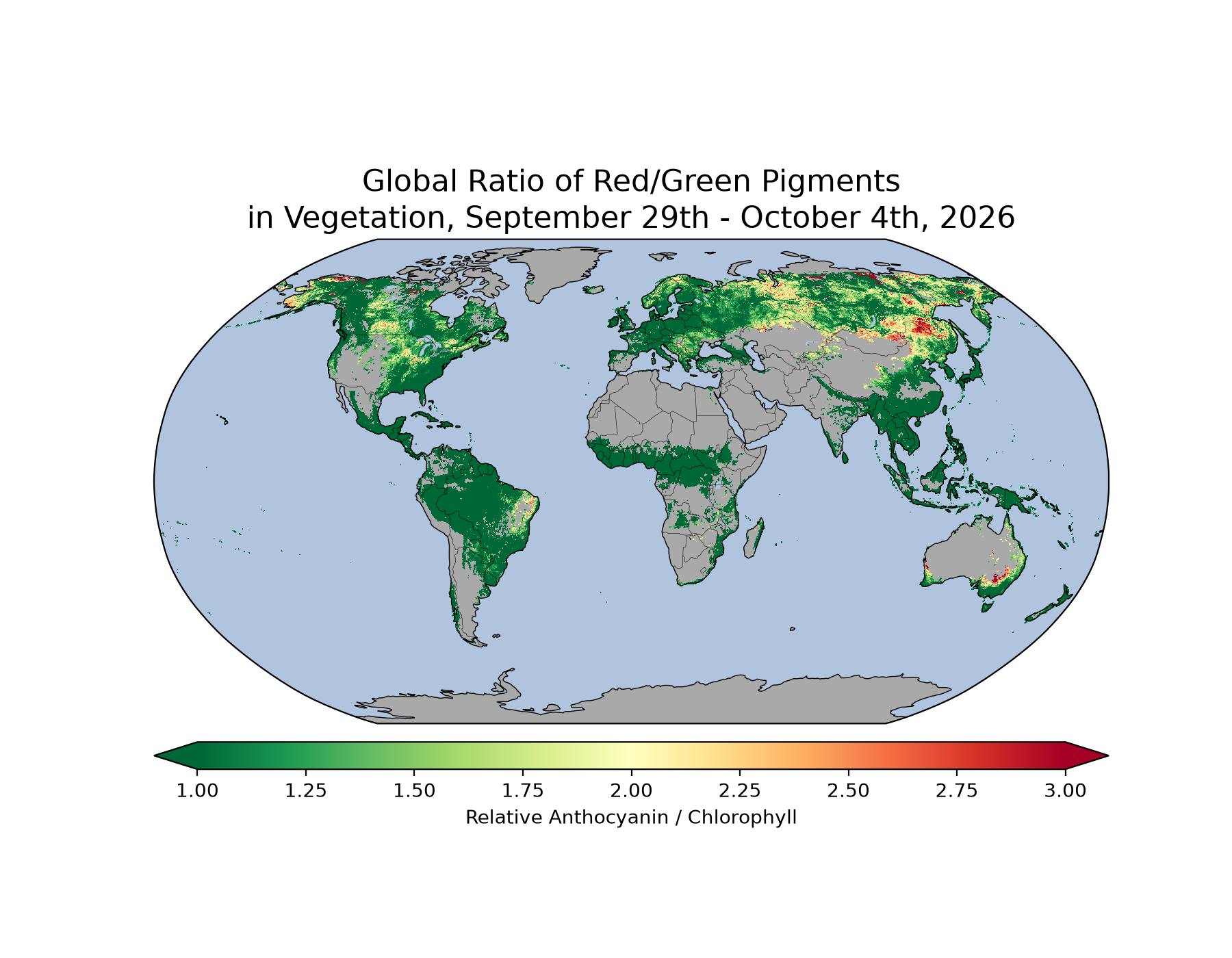
Globally, strong red pigment continues to develop across Southwestern Alaska and near the treeline in northern Alaska. Colors are also appearing all across Russia and northeastern China as the larches continue to lose their needles. Forests in Northern Europe continue to develop more anthocyanin and are gaining presence on the map. Color is also increasing across North America, with Canada and the northeastern and midwestern United States showing high anthocyanin signal. Meanwhile, countries in the southern hemisphere continue showing high relative chlorophyll as they inch toward the summer months. Expand September 29 global image.
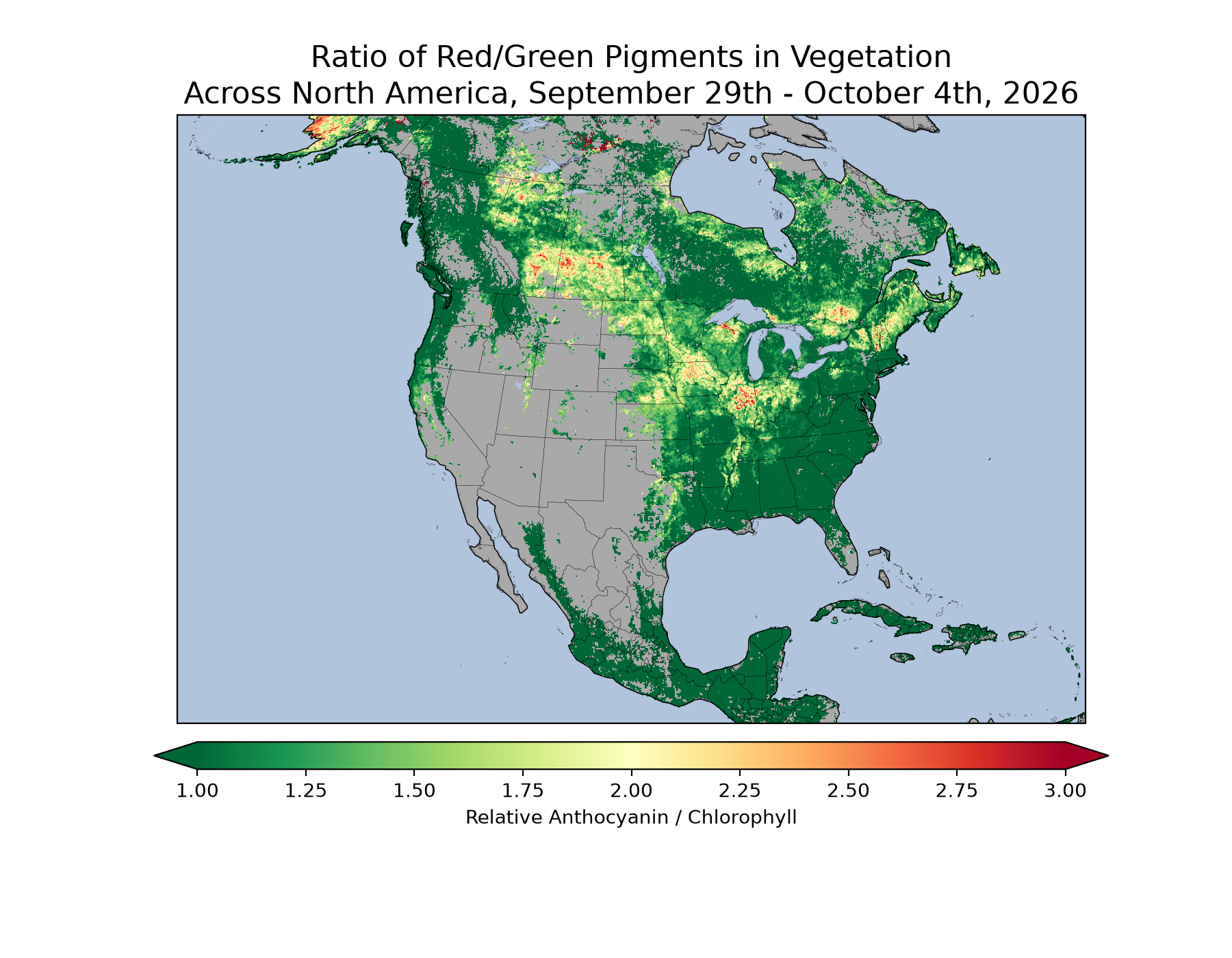
This week, from September 29–October 4, we can see that fall colors are emerging in the Laurentian Mountains of Quebec and in the North Woods of Wisconsin, along with the unglaciated Allegheny Plateau along the Pennsylvania-New York border. Red pigments are intensifying in Southern Quebec, New York, and New England, specifically in the Adirondacks, the Green Mountains, and the White Mountains. These pigments are likely due to the maple, beech, and birch trees at higher elevations that have turned bright red and yellow. Agricultural areas continue showing strong anthocyanin signals as well. Expand September 29 North America image.
September 22nd-28th, 2026
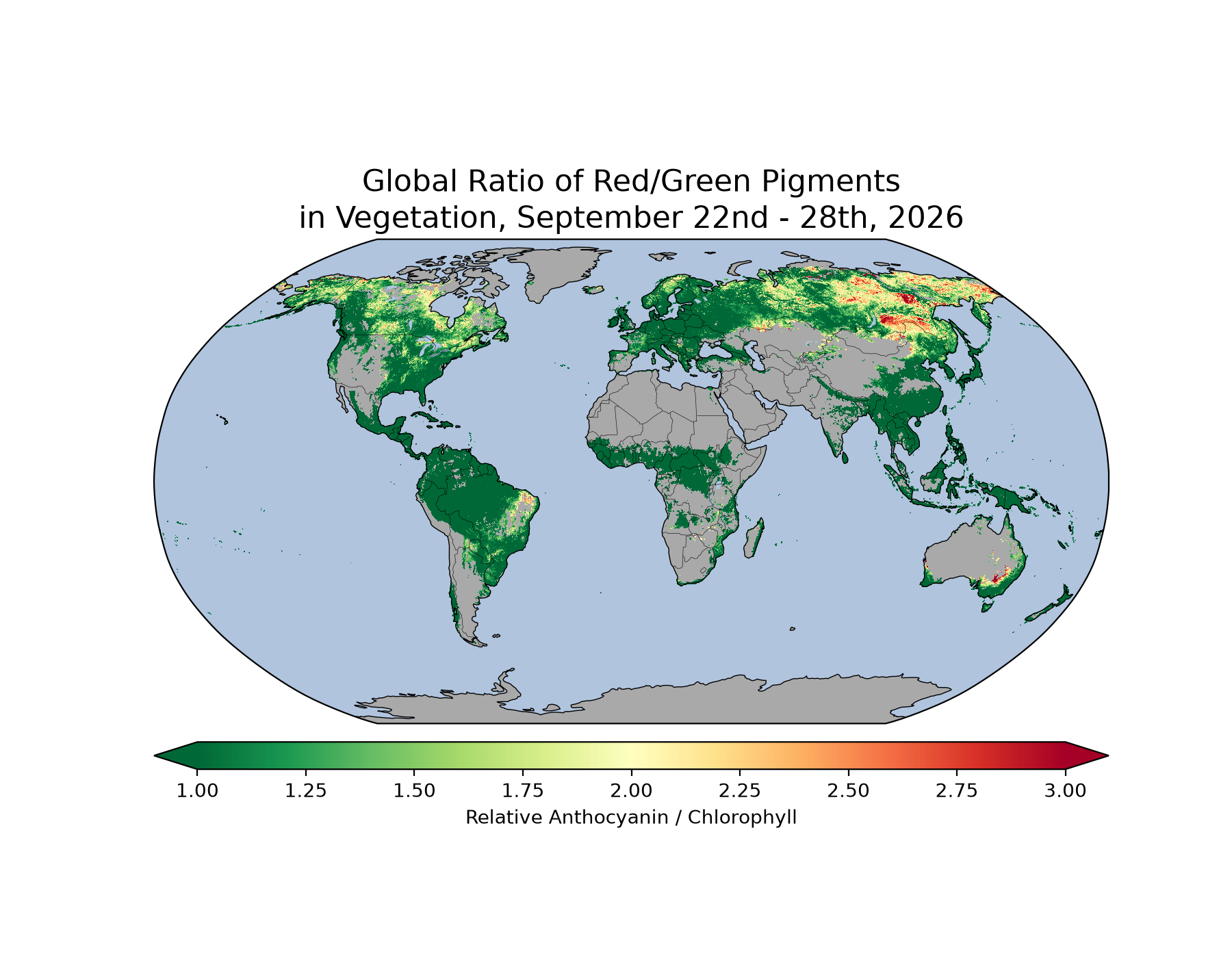
Globally, color is spreading across Northern European countries like Sweden and Norway. Anthocyanin signals across North American countries are intensifying as well, while forests in countries across East Asia and Central/Western Europe continue to show relatively high amounts of chlorophyll. The strong color change in eastern Siberia is because boreal forests are dominated by larch trees, which are deciduous conifers, that is, needle-leaved trees who lose their needles in the fall and grow new ones in the spring. Expand September 22 global image.
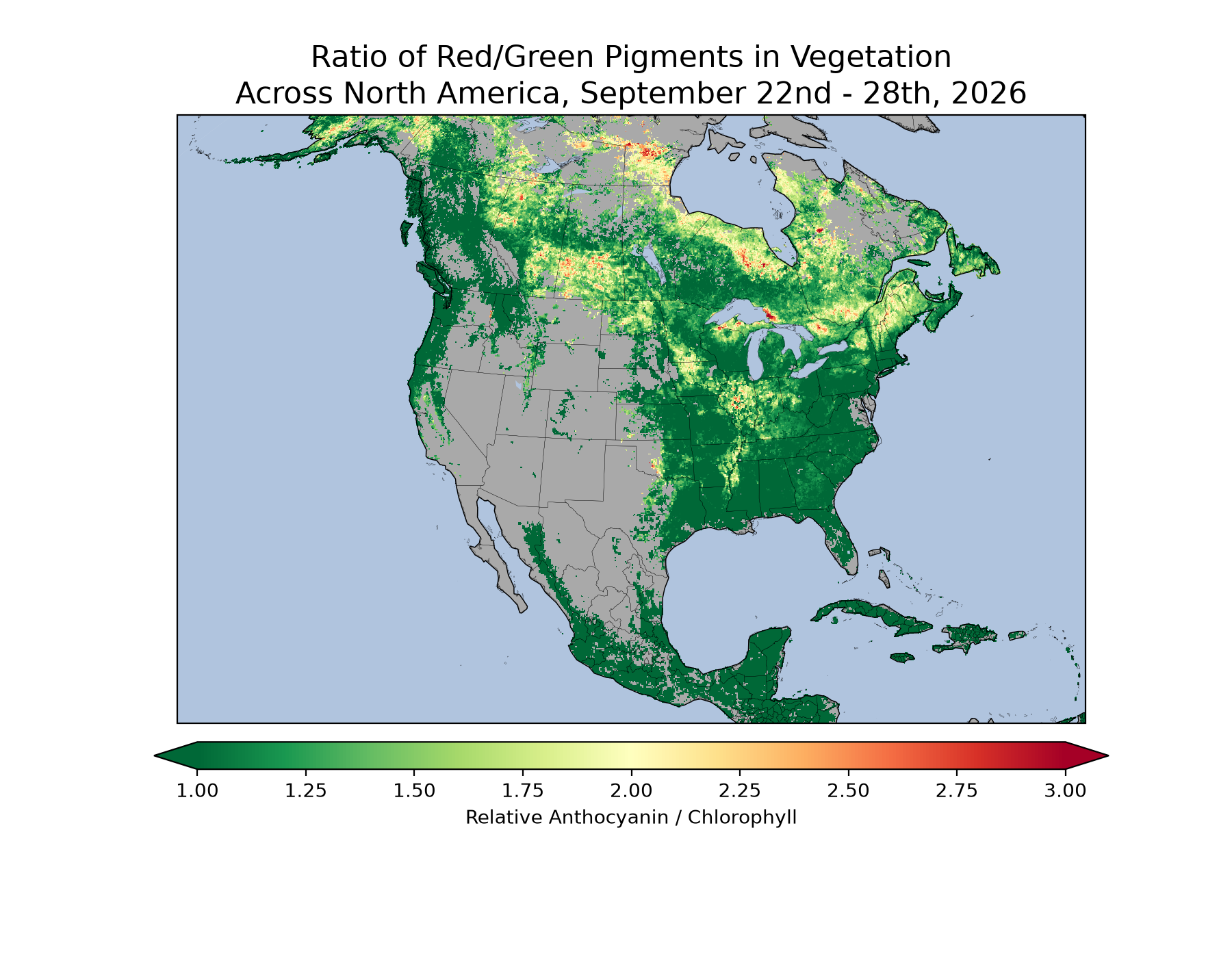
This week, from September 22nd - 28th, we can see that red pigments are spreading across Canada and the northeastern United States, with colors appearing throughout much of Quebec and Ontario, as well as in the mountains in New England and northern New York. The Hudson Bay Lowlands and Great Lakes regions continue to show higher values of anthocyanin. Red pigment in agricultural areas is increasing as well, with the corn belt across the United States showing a concentrated amount of anthocyanin compared to last week’s figures. Expand September 22 North America image.
September 14th-21st, 2026
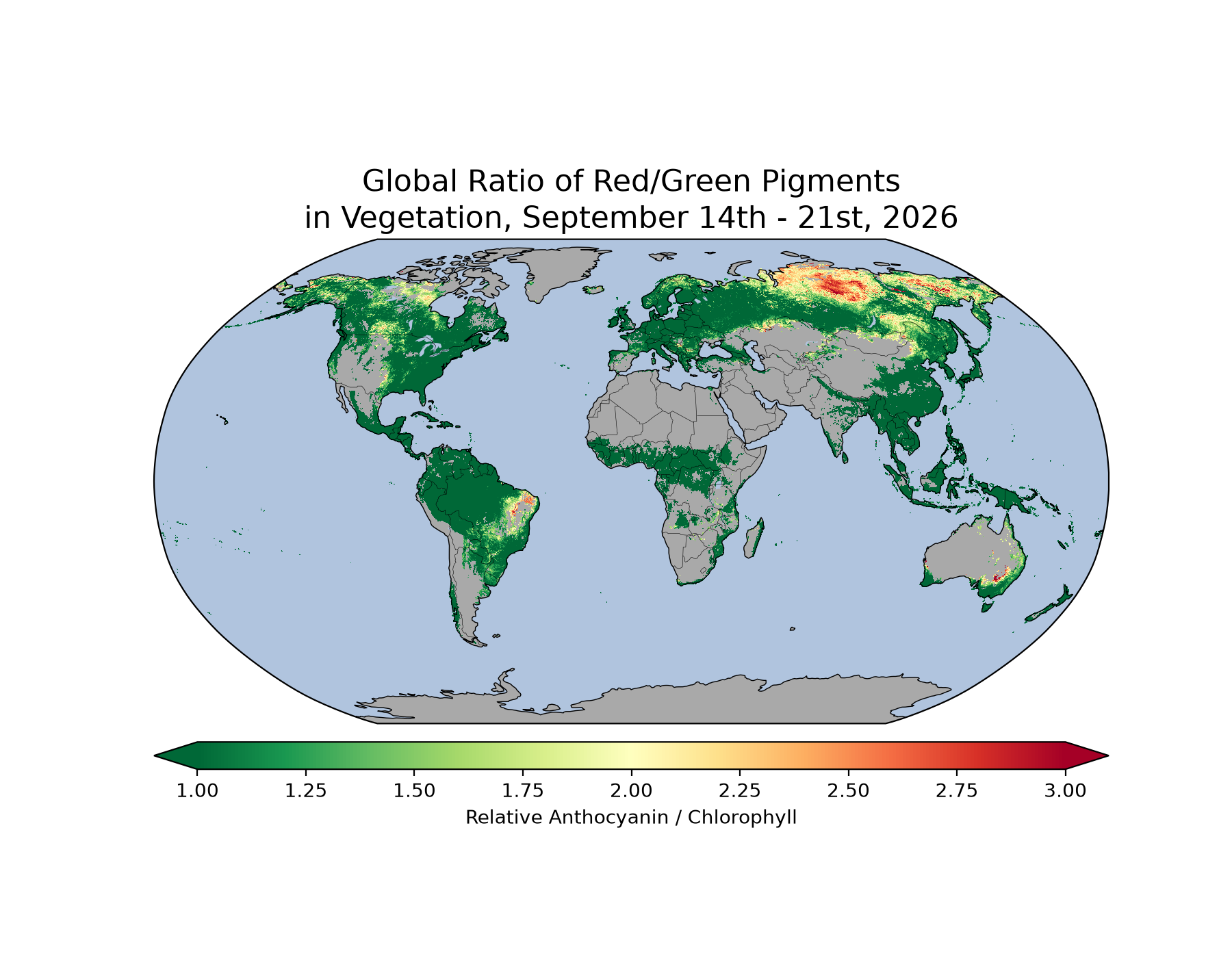
Globally, Siberia is starting to see very high values of red pigment compared to greens as we reach the first official days of autumn. The same changes are starting to be seen in Northern Europe and Canada. Shifts in pigment can also be seen in some agricultural areas in Brazil and the Canadian Prairies. Expand September 14 global image.
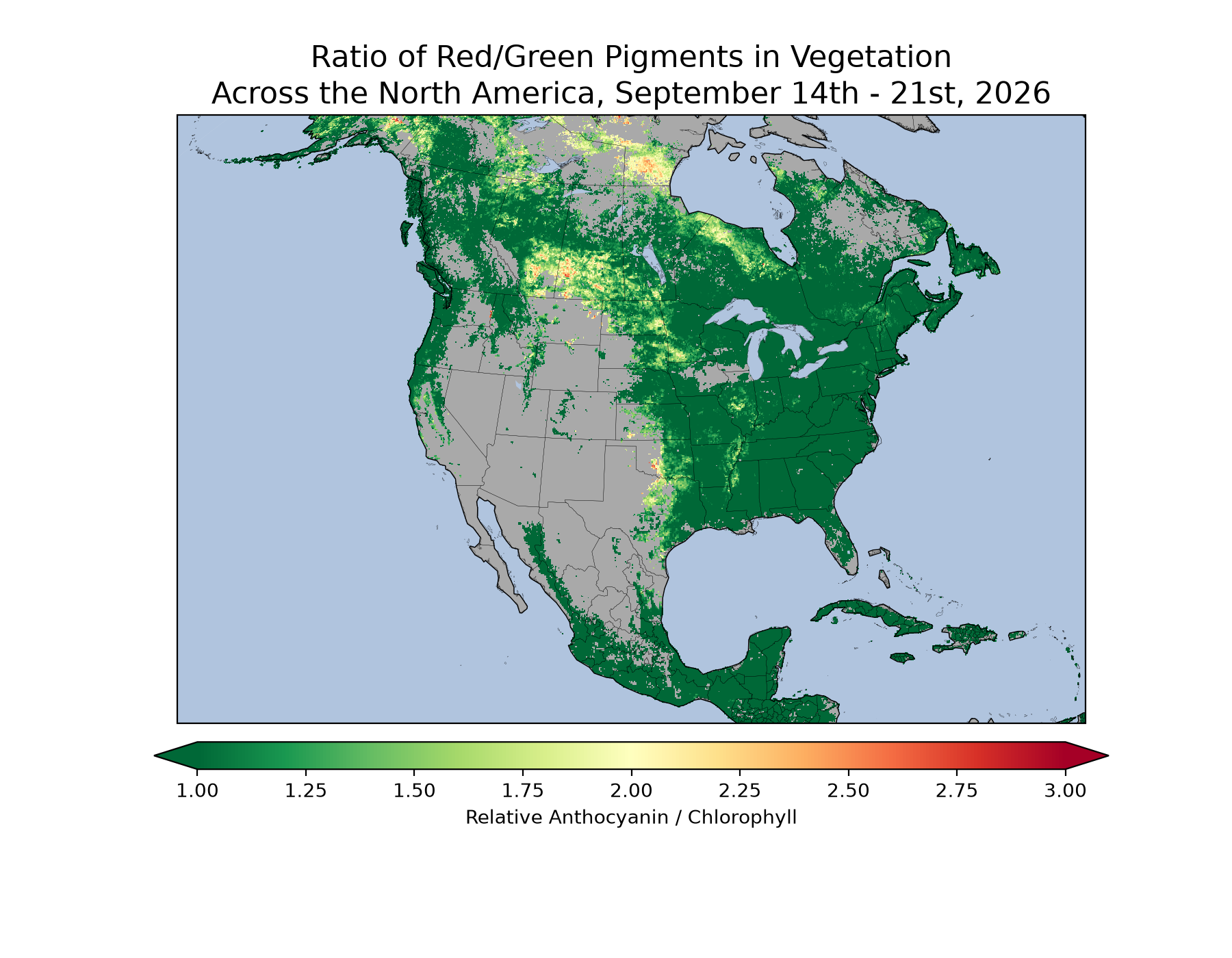
This week, from September 14– 21, we can see higher amounts of red pigment starting to appear across northern Canada and Hudson Bay Lowlands. Some of those same pigments are appearing in the agricultural areas of the Canadian Prairies and along the banks of the Mississippi River in the United States. The color changes visible in central Canada are likely due to the aspen woodlands of the southern boreal forest changing color. Expand September 14 North America image.
September 6th-13th, 2026


August 29-September 5, 2026


August 21-28, 2026


August 13-20, 2026


August 5-12, 2026



Alaska
Alaska-specific PACE images