

Community Blogs
Open social media sharing options menu



Community Blogs
Discover how the GLOBE community is engaging in all things GLOBE through the community blog posts below.
Learn how to create a GLOBE community blog post.
Filter By:
Blogs List
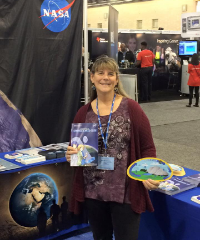
One of NASA's scientists, Dr. Stephanie Uz, has been working closely with the GLOBE ENSO Campaign throughout its beginning. She is an oceanographer who studies the response of ocean biology to physical forcing through remotely sensed satellite data, in situ measurements, model output and statistical reconstructions using proxies. Her research focuses on variability in global ocean color or chlorophyll concentrations, the pigment in microscopic phytoplankton, and the physical mechanisms causing those changes. Dr. Uz coordinates communication for the Plankton, Aerosol, Cloud, ocean ...
Read More »
Posted in:
Curriculum:
EDUCATION RESEARCH
SCIENCE AND MATH
TECHNOLOGY
Field Campaigns:
EL NIÑO
GLOBE Science Topics:
EARTH AS A SYSTEM
SCIENTIST SKILLS
EARTH SYSTEM SCIENCE
CLIMATE CHANGE
CLIMATE
Investigation Areas:
ATMOSPHERE
EARTH AS A SYSTEM
HYDROSPHERE
BIOSPHERE
Learning Activities:
EARTH AS A SYSTEM
ATMOSPHERE AND CLIMATE
HYDROLOGY
Primary Audience:
TRAINERS
TEACHERS
STUDENTS
PARTNERS
SCIENTISTS
ALUMNI
COUNTRY COORDINATORS
Teacher's Guide:
INVESTIGATION AREA DOCUMENTS

In most scientific research an important test is whether the results of an experiment can be repeated, typically repeated by another lab and research group. A result that cannot be confirmed in this way is generally viewed as invalid. This is a great test for controlled experiments where virtually identical experimental conditions may be achieved.
In Earth science research involving observations of the natural world, experimental conditions cannot be reproduced. For environmental research the standard must switch for repeatable to intercomparable – capable of being compared. ...
Posted in:
GLOBE Science Topics:
GENERAL SCIENCE
EARTH SYSTEM SCIENCE
BACKYARD SCIENCE
GLOBE PROTOCOLS
Investigation Areas:
HYDROSPHERE
PEDOSPHERE (SOIL)
ATMOSPHERE
BIOSPHERE
Primary Audience:
TRAINERS
TEACHERS
STUDENTS
SCIENTISTS
ALUMNI

There are many application for SMAP soil moisture satellite data.
Understanding drought risk is vital to the health of the planet and to the lives of potentially billions of people around the world. Soil moisture strongly affects plant growth and hence agricultural productivity, especially during conditions of water shortage and drought. Currently, there is no global in situ network for soil moisture monitoring. Global estimates of soil moisture and plant water stress must be derived from models. These model predictions (and hence drought monitoring) can be greatly enhanced through ...
Posted in:
Field Campaigns:
SMAP
GLOBE Science Topics:
EARTH SYSTEM SCIENCE
Investigation Areas:
SOIL MOISTURE - SMAP BLOCK PATTERN
PEDOSPHERE (SOIL)
Primary Audience:
TEACHERS
TRAINERS
STUDENTS
PARTNERS
SCIENTISTS
ALUMNI
COUNTRY COORDINATORS