

News - Mpumalanga Science and Technology Academy



Celebrating the 30 Years of GLOBE Campaign: Comparing Data Past and Present
 Thank you to everyone who helped celebrate GLOBE’s 30th Anniversary by participating in the 30 Years of GLOBE Campaign: Comparing Data Past and Present, which concluded in December 2025. During the campaign, more than 24 million data points were contributed to the GLOBE database by 58,000 community members representing over 1,300 organizations—an extraordinary accomplishment that further strengthens GLOBE’s collection of more than 280 million measurements worldwide.
GLOBE community members engaged in the campaign through a wide range of activities, including collecting and submitting data to the GLOBE database; comparing and analyzing newly collected data with historical records; collaborating with classrooms both locally and globally; taking action within their communities; submitting student research reports; and participating in campaign webinars. Student and educator involvement was especially strong, highlighted by a record-breaking number of student research reports submitted to the 2025 International Virtual Science Symposium (IVSS). Students also showcased their creativity by contributing logo designs for the 30 Years of GLOBE Campaign, culminating in a final logo inspired by 36 student designs from around the world.
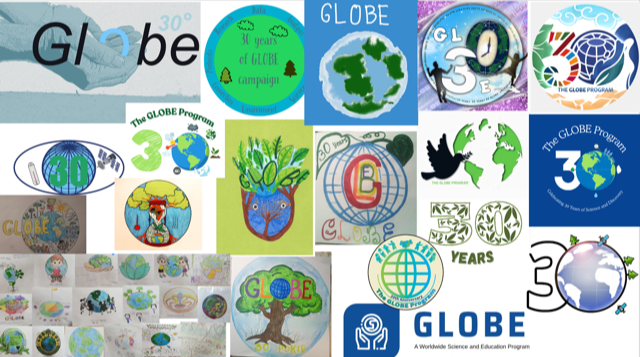
Above: A collage of student designs submitted to the 30 Years of GLOBE Campaign logo design contest.
Nine campaign webinars were held throughout the year, beginning with the 30 Years of GLOBE Campaign Kick-off in October 2024, facilitated by Dr. Charles Vörösmarty, GIO-STEPE Science Lead. Dr. Vörösmarty emphasized the critical role of GLOBE data collection in supporting solutions-oriented approaches to understanding and addressing Earth’s changing environments.
Webinar highlights included GLOBE Surface Temperature Protocol – Development of a Unique Data Set to Study the Earth, presented by Dr. Kevin Czajkowski of the University of Toledo. Dr. Czajkowski traced the development of the GLOBE Surface Temperature protocol since its inception in 1999, described its evolution over the past two decades, and shared examples of the hundreds of student research projects generated through Urban Heat Island Effect Intensive Observation Periods (IOPs).
Additional highlights included GLOBE Land Cover: A 10-Year Retrospective (1995–2005), presented by Dr. Russ Congalton, GLOBE’s Remote Sensing/Land Cover Principal Investigator from 1995 to 2007. Dr. Congalton reflected on the foundational steps taken during GLOBE’s early years to create a robust student learning environment while producing meaningful scientific data. Participants also learned about a joint mission launched in 2025 by NASA and the Indian Space Research Organization during the webinar NISAR: Imaging Radar Unveiling the Changing Earth, facilitated by Dr. Kyle McDonald of NASA’s Jet Propulsion Laboratory and the City University of New York. Dr. McDonald explained how NISAR’s advanced imaging radar enables continuous monitoring of Earth’s terrestrial ecosystems, cryosphere, and dynamic surface and interior, and highlighted the important role GLOBE plays in providing complementary ground-based observations.
Thank you to all of the webinar presenters for sharing their expertise and demonstrating the impact of GLOBE data and citizen science in advancing Earth system science.
We extend our sincere thanks to the nearly 200 GLOBE community members—including educators, students, citizen scientists, and scientists—who shared how they participated in the campaign by submitting the Campaign Participation form. Their reflections highlight the diverse and meaningful ways the GLOBE community engaged throughout the campaign, and a selection of their quotes is shared below.
“The students of our school regularly enter data about the yellowing of the leaves on the trees around our school, on two linden trees, a fig tree and a cherry tree. We regularly exchange data and compare it with other schools across Europe. We have observed the same trees during autumn and spring for many years and already have a large database for our trees. We also measure the height of the same trees using a clinometer and the GLOBE Observer application, which the students really like.”
“I began working with my students through the GLOBE Program in 2000. I was excited to return to sampling at those sites with new students. One student had even conducted a similar study 10 years earlier. It started in the science club 10 years ago.”
“As a mentor to many students who have participated over the years, and new students who participate in various GLOBE activities, this program has become an indispensable part of my teaching – whether through extracurricular activities or geography classes. The most beautiful moments are those spent in nature, where we explore, measure and learn through experience together. Every outing in the field brings a new discovery, and along with scientific work, we also strengthen our community, share a passion for research and build a love for the environment.”
“I have been participating in the GLOBE Program for 25 years, promoting school-based scientific research and environmental monitoring. As part of the 30th Anniversary GLOBE Campaign, we returned to some of the original sampling sites, as well as newer locations, to evaluate changes in the water quality of the Chimehuín River—an ecosystem impacted by volcanic ash fallout on two occasions, in addition to anthropogenic influences. This experience allowed us to compare historical and current data, encouraging critical analysis and environmental awareness among new generations.”
Thank you to everyone who contributed to the success of the 30 Years of GLOBE Campaign!
News origin: GLOBE Implementation Office